The Crusade That Began With a Massacre at Home
The First Crusade was meant to march on Jerusalem. Its first victims were thousands of Jewish men, women and children in the cities of the Rhine. Many were cut down by crusaders. Many more, cornered and offered baptism or death, chose to die by their own hands.
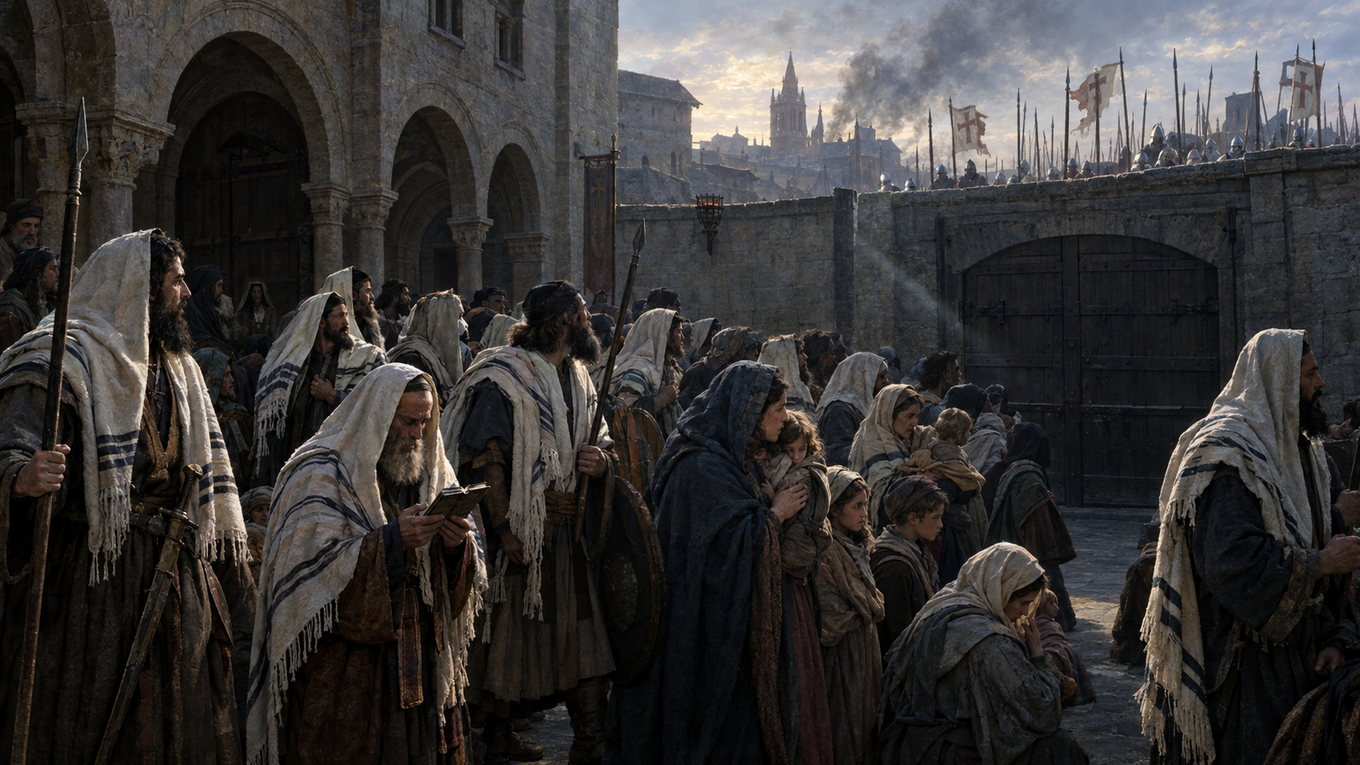
On the morning of the 27th of May 1096, the Jews of Mainz were crowded into the palace of their archbishop. They had paid him to protect them, and they had armed themselves as best they could. Outside the walls was the army of Count Emicho, a Rhineland nobleman who had taken the cross and claimed to have been chosen by God. By noon, someone had opened the city gate.
By the end of the day, more than a thousand Jews were dead. Some were cut down by the crusaders as they broke into the palace courtyard. Many more, knowing what was coming, killed their own families and then themselves rather than be killed or forcibly baptised. It was the worst of a wave of massacres that swept the Jewish communities of the Rhine in the spring of 1096. The First Crusade had not yet reached Jerusalem. Its first victims were in the heart of Christian Europe.
The cities of the Rhine
By the eleventh century, the Rhineland was home to some of the most important Jewish communities in Europe. In Speyer, Worms and Mainz they had synagogues, schools and scholars famous across the Jewish world. In Hebrew the three cities were known together by their initials as ShUM. Many of their Jews were merchants and moneylenders who had lived for generations under the protection of bishops and the emperor.
In November 1095, Pope Urban II called on the knights of Christendom to march east and free Jerusalem from Muslim rule. The response was overwhelming, and it was not limited to knights. Preachers like Peter the Hermit stirred up huge crowds of ordinary people, and bands of would-be crusaders gathered across France and Germany in the spring of 1096. Some of them asked an obvious question. Why march thousands of miles to fight the enemies of Christ, when Jews, whom many Christians blamed for the crucifixion, lived in the next street?
Money mattered too. Crusading was expensive, and many crusaders had gone into debt to equip themselves. The Christian chronicler Albert of Aachen, who condemned the massacres, believed they were carried out “through greed of money, rather than for the sake of God’s justice.” The Jews of the Rhine had warning. When French Jews sent letters describing the threats against them, the Rhineland communities declared a fast, and the Jews of Mainz and Cologne paid the crusade leader Godfrey of Bouillon 500 silver marks each for his protection.
Speyer and Worms
The first blood was shed in May. At Speyer, on the 3rd, crusaders and a crowd of hangers-on attacked the Jews and killed eleven of them before Bishop John stepped in and sheltered the rest.
Worms was far worse. On the 18th of May a rumour swept the town that the Jews had boiled a Christian corpse and poured the water into the wells to poison the town. Crusaders and townspeople fell on the Jews who had stayed in their homes. Houses were destroyed, and even the corpses were stripped. Those who had fled to the bishop’s palace survived for a week. On the 25th of May, the palace was stormed. According to the 1906 Jewish Encyclopedia, which drew on the medieval memorial lists, around 800 Jews died at Worms, though only some 400 names survive. One wealthy woman named Minna was begged by noble friends to accept baptism and save herself. She refused and was killed. A man named Mar Shemariah and his whole family were buried alive while the crowd jeered, offering to let them live if they would convert.
The slaughter at Mainz
Mainz had the largest Jewish community on the Rhine, and its leaders did everything they could. They paid Archbishop Ruthard and the town’s officials to protect them, and the archbishop gathered the Jews into his palace. Many Christian townspeople, who had worked alongside Jews for years, helped them. For two days the gates held against Emicho, whose army the chronicler Ekkehard of Aura put at nearly twelve thousand. Then, on the 27th of May, according to the Hebrew chronicle, townspeople opened the gate to them.
The Hebrew chronicle of Solomon bar Samson, written about forty years later, describes what happened. The Jews of Mainz put on their armour and tried to hold the palace gate under their leader, Kalonymus ben Meshullam. But they were weak from fasting and hopelessly outnumbered. “The bishop’s men, who had promised to help them, were the very first to flee,” the chronicle says, and “even the bishop himself fled from his church.”
As the crusaders broke into the courtyard, a group of the most devout Jews sat waiting for them, wrapped in their prayer shawls. Their leader, Isaac ben Moses, “stretched out his neck, and his head they cut off first.” The rest were killed with stones, arrows and swords.
Those still inside the palace rooms saw what was coming. Rather than be killed by the crusaders or dragged to the font, they chose kiddush ha-Shem, death for the sanctification of God’s name. The chronicle describes how they checked that their knives had no nicks, as for a ritual slaughter, and began to kill each other: “The women there girded their loins with strength and slew their sons and their daughters and then themselves. Many men, too, plucked up courage and killed their wives, their sons, their infants.” In a passage that makes for a difficult read, it lists the dead: “The blood of the men mingled with their wives’, the blood of the fathers with their children’s… and the blood of infants and sucklings with their mothers’.”
The Christian chronicler Albert of Aachen describes the same scene from the other side. The crusaders attacked “with arrows and lances,” he writes, broke down the doors and “with their swords pierced tender children of whatever age and sex.” Seeing that no one was being spared, the Jews “fell upon one another, brother, children, wives, and sisters… Horrible to say, mothers cut the throats of nursing children with knives.”
Rachel of Mainz
One story from that day has been remembered above all the others. Rachel, the daughter of Isaac ben Asher, had four children: two sons, Isaac and Aaron, and two daughters, Bella and Matrona. Determined that they would not be taken and raised as Christians, she asked a friend to kill them.
When the friend took the knife to little Isaac, Rachel begged her not to do it in front of his brother, “lest Aaron see his brother’s death and run away.” It was too late. Aaron saw, screamed “Mother, mother, do not butcher me,” and hid under a chest. Rachel’s daughters sharpened the knife themselves. When the three were dead, Rachel dragged Aaron out from his hiding place by his foot and killed him too. When the crusaders burst in, they found her sitting with her children laid beside her under her sleeves. Thinking she was hiding money, they demanded to see it. When they saw the children, they killed her. Her husband, seeing his family dead, fell on his own sword.
The chronicles count around 1,100 dead at Mainz in a single day. Albert of Aachen gives a lower figure of about seven hundred. Afterwards, the crusaders held a service of thanksgiving in the archbishop’s palace.
A handful escaped. Kalonymus and some fifty others hid in the cathedral treasury, and Archbishop Ruthard smuggled them by boat up the Rhine to Rüdesheim. A few days later he told them he could only protect them if they were baptised. Rather than convert, they killed themselves. Kalonymus killed his own son, then, in his grief, tried to attack the archbishop and was killed.
Cologne and beyond
The killing spread down the Rhine. At Cologne, the archbishop and many of the citizens hid the Jews in their own houses, then sent them away to seven nearby villages for safety. The crusaders hunted them down. At Neuss and Altenahr, about two hundred were killed, some of the old women and young children thrown into the river. At Altenahr, the Jews of Cologne chose five men to kill the rest. At Trier, Jewish women threw themselves into the Moselle. At Regensburg, crusaders drove the whole community into the Danube and baptised them by force. Others were attacked at Metz, Magdeburg and Prague.
No one knows exactly how many died. The Jewish Encyclopedia estimated about four thousand, killed or by their own hands, in the Rhineland alone. Some modern estimates are higher.
Emicho’s army never reached the Holy Land. When it tried to force its way into Hungary, King Coloman closed the border. After a six-week siege of the fortress of Wieselburg, the crusaders broke and fled in panic, and many were cut down or drowned. To Albert of Aachen, it was divine justice: “The Lord is a just judge and orders no one unwillingly, or under compulsion, to come under the yoke of the Catholic faith.”

Questions and answers
What happened to the Jews who were forcibly baptised?
Most returned to Judaism as soon as they could. When Emperor Henry IV came back from Italy in 1097, he formally allowed Jews who had been baptised by force to return to their faith, despite protests from the pope he supported, Clement III. Christian law usually held that baptism could not be undone, so it was an unusual decision.
Was anyone punished?
Very few. Bishop John of Speyer, who had stopped the killing in his city, had some of the attackers’ hands cut off. Henry IV, who had urged the German princes to protect the Jews, later ordered an inquiry into the theft of Jewish property. But the crusaders moved on before local courts could act, and there is no record that Emicho or his lieutenants were ever brought to justice. Archbishop Ruthard of Mainz was himself accused of taking a share of the plunder.
Was this the beginning of European antisemitism?
Not exactly, but it was a turning point. There had been attacks on Jews in Europe before, including in Metz in 888 and Limoges in 992, and some kings had forced Jews to convert around 1007 to 1012. But nothing on this scale had happened in centuries. The historian David Nirenberg has noted that 1096 is often presented in modern Jewish history as the first instance of an antisemitism “that would henceforth never be forgotten.” Later crusades brought new threats and attacks, from the anti-Jewish preaching that accompanied the Second Crusade in the Rhineland in 1146 to the massacres of the Shepherds’ Crusades in France and Spain in the thirteenth and fourteenth centuries.
How are the victims remembered today?
In synagogues around the world. In the late eleventh or early twelfth century, a prayer called Av HaRachamim, “Father of Mercy,” was written in memory of the martyred communities. It is still recited in many Ashkenazi synagogues on the Sabbath. The Hebrew chronicles of 1096 were themselves written partly as memorials, recording the names of the dead so they would not be forgotten.
Can you visit the places where it happened?
Yes. The Jewish communities of Speyer, Worms and Mainz rebuilt after 1096 and became great centres of Jewish learning again. Their surviving medieval sites, including the synagogue and ritual bath in Speyer, the synagogue in Worms and the “Holy Sand” cemetery in Worms, one of the oldest Jewish cemeteries in Europe, were made a UNESCO World Heritage Site in 2021 as the “ShUM Sites of Speyer, Worms and Mainz.”
Key dates
- November 1095
- Pope Urban II preaches the First Crusade at Clermont
- Spring 1096
- Crusading bands gather in France and Germany; 22 Jews are killed at Metz
- 3 May 1096
- Crusaders attack the Jews of Speyer; eleven are killed before the bishop intervenes
- 18–25 May 1096
- The Jewish community of Worms is massacred, first in their homes and then in the bishop's palace
- 27 May 1096
- Count Emicho's army storms the archbishop's palace at Mainz; more than a thousand Jews die in a single day
- May–June 1096
- The Jews of Cologne are hunted down in the villages where they had been hidden; attacks follow at Trier, Regensburg and Prague
- Summer 1096
- Emicho's army is routed by the Hungarians at Wieselburg (Moson)
- 1097
- Emperor Henry IV allows Jews who had been forcibly baptised to return to Judaism
Further reading

The First Crusade: A New History
Thomas Asbridge · A history of the First Crusade from Urban II's call to arms through to Jerusalem, covering the crusade's wider context and its early violence in Europe.
View on Bookshop.org: The First Crusade: A New History
A History of the Crusades I: The First Crusade and the Foundation of the Kingdom of Jerusalem
Steven Runciman · The first volume of Runciman's classic narrative history of the Crusades, covering the march east and the violence that preceded it.
View on Bookshop.org: A History of the Crusades I: The First Crusade and the Foundation of the Kingdom of Jerusalem
The First Crusade: The Call from the East
Peter Frankopan · A history of the First Crusade told with particular attention to the Byzantine perspective and the crusade's wider causes.
View on Bookshop.org: The First Crusade: The Call from the EastThis article contains affiliate links. If you buy through them, Yorewire may earn a small commission at no extra cost to you. Affiliate disclosure.
Sources
- 1Solomon bar Samson, Chronicle (c. 1140), excerpts trans. Jacob Marcus, The Jew in the Medieval World (1938), via the Internet Medieval Sourcebook (The longest of the three Hebrew chronicles of 1096, written by a later generation; source for the massacre at Mainz and the story of Rachel and her children.)
- 2Albert of Aachen and Ekkehard of Aura, accounts of Emicho, trans. August C. Krey, The First Crusade (1921), via the Internet Medieval Sourcebook (The Christian chroniclers' accounts of the massacres and of Emicho's army.)
- 3Richard Gottheil and Joseph Jacobs, 'Crusades, The', Jewish Encyclopedia (1906) (Scholarly summary drawing on the Hebrew chronicles and the medieval memorial lists; source for the town-by-town details and death tolls.)
- 4'Rhineland massacres', 'Worms massacre (1096)' and 'Emicho (crusader)', Wikipedia (Used for background and modern historiography; drawing on Robert Chazan, David Nirenberg and others.)
- 5'ShUM Sites of Speyer, Worms and Mainz', SchUM-Städte e.V. (On the surviving medieval Jewish sites of the three cities, a UNESCO World Heritage Site since 2021.)