The Olympic Champion Who Won His Final After He Died
Arrhachion of Phigalia had already won the Olympic pankration twice. In the final of 564 BC his opponent locked his legs around him and choked him from behind. With his last strength Arrhachion wrenched his opponent's foot out of joint. The man gave up in agony, and the judges turned to find the winner dead.
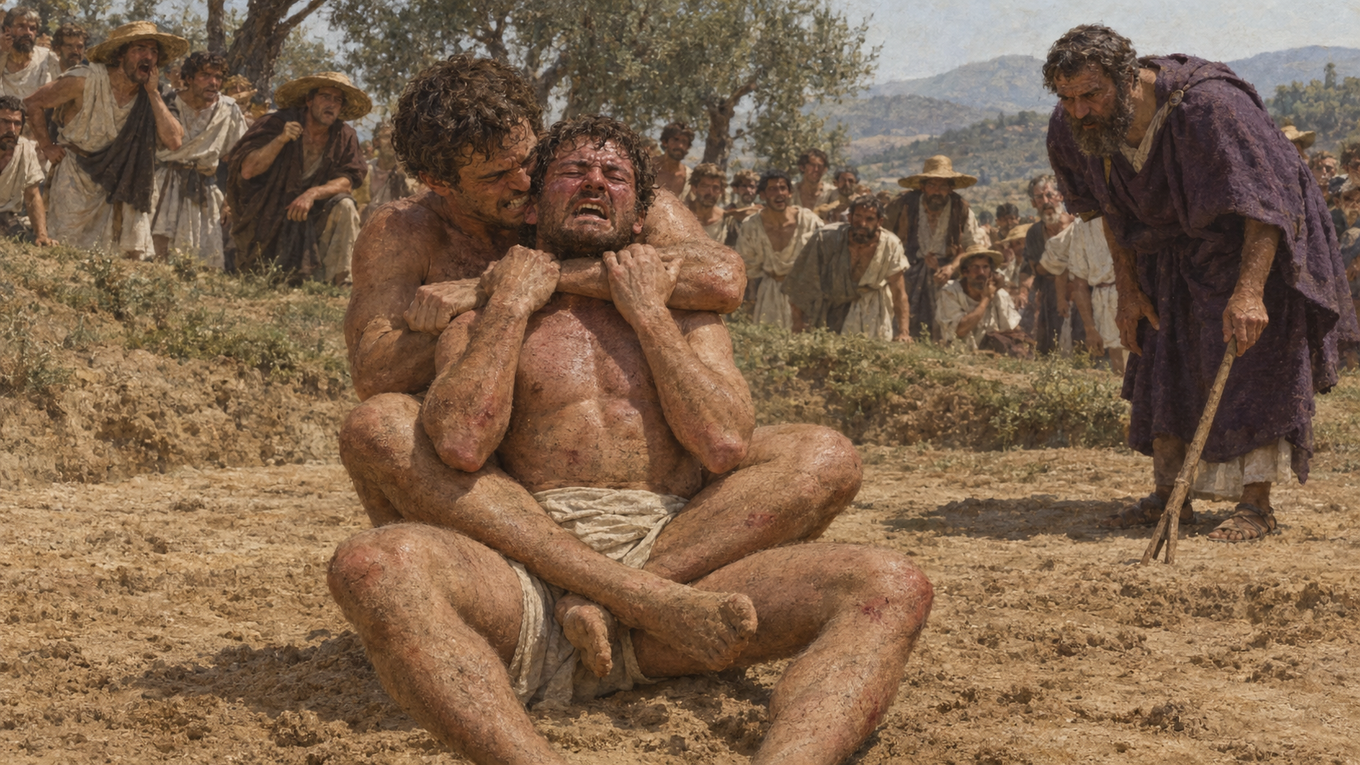
At the Olympic Games of 564 BC, the crowd at the stadium in Olympia watched two men locked together in the dust. One of them, Arrhachion of Phigalia, was the reigning champion, going for his third title in a row. He was losing. His opponent had climbed onto his back, wrapped his legs around his body and clamped his forearm across his throat, and he was slowly choking him to death.
Then Arrhachion did something that made him the most famous pankration fighter of antiquity. With the last of his strength, he twisted his opponent’s foot out of its joint. The man cried out and raised his hand to surrender. But by the time the judges separated them, Arrhachion was dead. The judges declared him the winner anyway, and placed the olive crown on his corpse.
The fight with no rules
The pankration, which means “all strength” or “all power,” was the most brutal event at the ancient Olympics. It was added to the Games in 648 BC and combined boxing, wrestling and kicking. There were no weight classes, no rounds and no time limit. A fight ended only when one man raised his hand to give up, was knocked senseless, or died.
Almost anything was allowed. The writer Philostratus, describing the event in the third century AD, says that fighters had to take blows to the face, choke their opponents “in different ways at different times,” wrench ankles and twist arms. At Olympia there were only two rules: no biting and no gouging. The Spartans, Philostratus adds, allowed even those, because they saw the pankration as training for war.
The prize was a crown of leaves from a sacred wild olive tree at Olympia. The fame that came with it was worth far more. Champions were celebrated in poems, honoured with statues and often fed at public expense for the rest of their lives.
The champion from the mountains
Arrhachion came from Phigalia, a small, remote town in the mountains of Arcadia, in the south-west of the Peloponnese. He won the pankration at Olympia in 572 BC and again in 568 BC. In 564 BC he came back to try for a third victory in a row, and he fought his way through to the final.
We do not know the name of his last opponent. Pausanias, the Greek travel writer who tells the story, calls him simply “the last remaining competitor, whoever he was.”
The death grip
Our two accounts agree on the outline but differ on the details. According to Pausanias, Arrhachion’s opponent “got a grip first, and held Arrhachion, hugging him with his legs, and at the same time he squeezed his neck with his hands.”
Philostratus gives a more vivid version, describing a painting of the fight. The opponent had grabbed Arrhachion around the middle and “thought to kill him.” He wound his forearm around Arrhachion’s throat “to shut off the breathing,” hooked his feet inside Arrhachion’s knees to pin his legs, and choked him “till the sleep of death thus induced began to creep over his senses.”
In a separate book on athletic trainers, Philostratus adds that Arrhachion’s trainer, a man named Eryxias, could see that his fighter was about to give up. He shouted from the edge of the ring that it would be a fine epitaph for a man to have: “He did not give up at Olympia.”
The last move
What Arrhachion did next, according to Philostratus, was a piece of brilliant technique. As his opponent relaxed the grip of his legs for a moment, Arrhachion kicked backwards with his right foot. He trapped his opponent’s foot inside the crook of his own knee, then threw his whole body down and to the left. The violent twist wrenched his opponent’s ankle “from its socket.”
The pain was too much and his opponent let go, raising his hand to show that he was beaten. Philostratus describes the painting showing him looking “like a corpse,” signalling his surrender, while Arrhachion, already dead, was painted as though alive, his skin flushed, the sweat still fresh on his body and a smile on his face.
According to Pausanias, the opponent was “forced to give in at the same time” that Arrhachion died. The judges of the Games, known as the Hellanodikai, ruled that the man who had surrendered had lost, whatever the state of the man who had beaten him. “The Eleans crowned and proclaimed victor the corpse of Arrhachion.”
The statue in the field
The people of Phigalia set up a stone statue of their champion in their market place. Pausanias saw it there more than 700 years later. He described it as very old-fashioned in style, with “the feet close together” and “the arms hang[ing] down by the side as far as the hips.” He was told it had once carried an inscription, but by his day the words had worn away.
Questions and answers
What actually killed him?
Pausanias says Arrhachion died of suffocation, but modern researchers have doubted it. A man being strangled usually loses consciousness well before he dies, and an unconscious man could not have carried out the twisting, throwing move that Philostratus describes. The historians of the Ancient Olympics project at KU Leuven suggest instead that when Arrhachion threw his body violently to one side while his opponent’s arm was still locked around his throat, his own neck broke, much like that of a man being hanged. If so, he did not die slowly in the stranglehold. He was killed instantly by the move that won him the fight.
Was he the only dead man ever to win a crown?
No. Pausanias tells a still more gruesome story about the boxer Creugas of Epidamnus at the Nemean Games. As night fell, Creugas and his opponent, Damoxenus of Syracuse, agreed to settle their bout by taking turns to land one free blow each. Creugas punched Damoxenus on the head. Damoxenus then told Creugas to lift his arm, and drove his straightened fingers into his opponent’s side so hard that his nails broke through the skin. He seized Creugas’s guts and tore them out. Creugas died on the spot. The Argives, who ran the Games, banished Damoxenus for breaking the agreement by dealing “many blows instead of one,” and awarded the crown to the dead man. They even put up a statue of Creugas in Argos.
Could you be punished for killing an opponent?
Sometimes. Death was an accepted risk in Greek combat sports, unlike in Roman arenas, where death was often the point, as at the Fucine Lake. But a fighter who killed by foul means could lose everything. At the Olympics of 492 BC the boxer Cleomedes of Astypalaea killed his opponent, Iccus of Epidaurus. The judges ruled that he had fought unfairly and took away his prize. According to Pausanias, Cleomedes went mad with grief. He went home to Astypalaea, broke into a school and pulled down the pillar holding up the roof, crushing about sixty children. When the townspeople stoned him, he hid in a chest in the temple of Athena and pulled the lid shut. When they finally broke it open, it was empty. The oracle at Delphi told them to worship him as a hero, and they did.
Did Arrhachion inspire Monty Python?
Indirectly, it seems. John Cleese has said that the Black Knight in Monty Python and the Holy Grail, who loses all four limbs and still refuses to give up, came from a story told by his English teacher. In the teacher’s version, a wrestler in ancient Rome broke his arm and submitted, and only then did the referee notice that the winner was dead. The moral, the teacher said, was that if you never give up, you cannot lose. Cleese told Wired in 2014 that he “always thought this was a very dodgy conclusion.” The details had become garbled, but the story is Arrhachion’s.
Key dates
- 776 BC
- The traditional date of the first Olympic Games
- 648 BC
- The pankration is added to the Olympic programme
- 572 and 568 BC
- Arrhachion of Phigalia wins the Olympic pankration
- 564 BC
- Arrhachion dies in the pankration final and is crowned champion for the third time
- About AD 150–180
- Pausanias sees Arrhachion's statue in the market place of Phigalia
- May 1890
- J. G. Frazer finds a headless archaic statue in a field at Phigalia, thought to be Arrhachion's
Further reading
Sport and Spectacle in the Ancient World
Donald G. Kyle · A standard history of ancient sport, including the pankration and the brutal combat events of the Olympics.
View on Bookshop.org: Sport and Spectacle in the Ancient World
Ancient Greek Heroes, Athletes, Poetry
Gregory Nagy · A Harvard classicist explores how the heroes of Greek poetry relate to the athletes who competed at festivals like the Olympics.
View on Bookshop.org: Ancient Greek Heroes, Athletes, PoetryThis article contains affiliate links. If you buy through them, Yorewire may earn a small commission at no extra cost to you. Affiliate disclosure.
Sources
- 1Pausanias, Description of Greece, 8.40.1–5 and 6.9.6–8, trans. W. H. S. Jones and H. A. Ormerod (Loeb Classical Library, 1918), via Theoi (The earliest surviving account of Arrhachion's death, by a Greek travel writer of the second century AD, with the stories of Creugas and Cleomedes.)
- 2Philostratus the Elder, Imagines 2.6, 'Arrichion', trans. Arthur Fairbanks (Loeb Classical Library, 1931), via Theoi (A description, written in the third century AD, of a painting of the fight, with the fullest account of the holds. The translator's note dates the fight to the 55th Olympiad; Pausanias says the 54th, which is 564 BC.)
- 3Philostratus, Gymnasticus 21, and 'Arrichion', Ancient Olympics, KU Leuven (The story of Arrhachion's trainer Eryxias, and the modern argument that he died of a broken neck rather than suffocation.)
- 4Walter Woodburn Hyde, Olympic Victor Monuments and Greek Athletic Art (Carnegie Institution, 1921), pp. 326–328, via the Internet Archive (On the discovery of the archaic statue at Phigalia believed to be Arrhachion's.)
- 5David Barr Kirtley, 'John Cleese on the Black Knight and Douglas Adams' High Heels', Wired, November 2014 (Cleese's account of the schoolroom story that inspired the Black Knight. Wikipedia attributes it to a DVD commentary.)
- 6'Arrhichion', Wikipedia (Used for background. It wrongly credits the description of the painting to Philostratus the Younger; it is in the Imagines of Philostratus the Elder.)