The Stolen Bucket Modena Has Kept for 700 Years
In November 1325 a small Ghibelline army from Modena smashed a Bolognese force several times its size, chased the survivors to the gates of Bologna and stole a bucket from a well outside the walls. The bucket is still on display in Modena's town hall, and the legend that it started the war is a seventeenth-century joke.
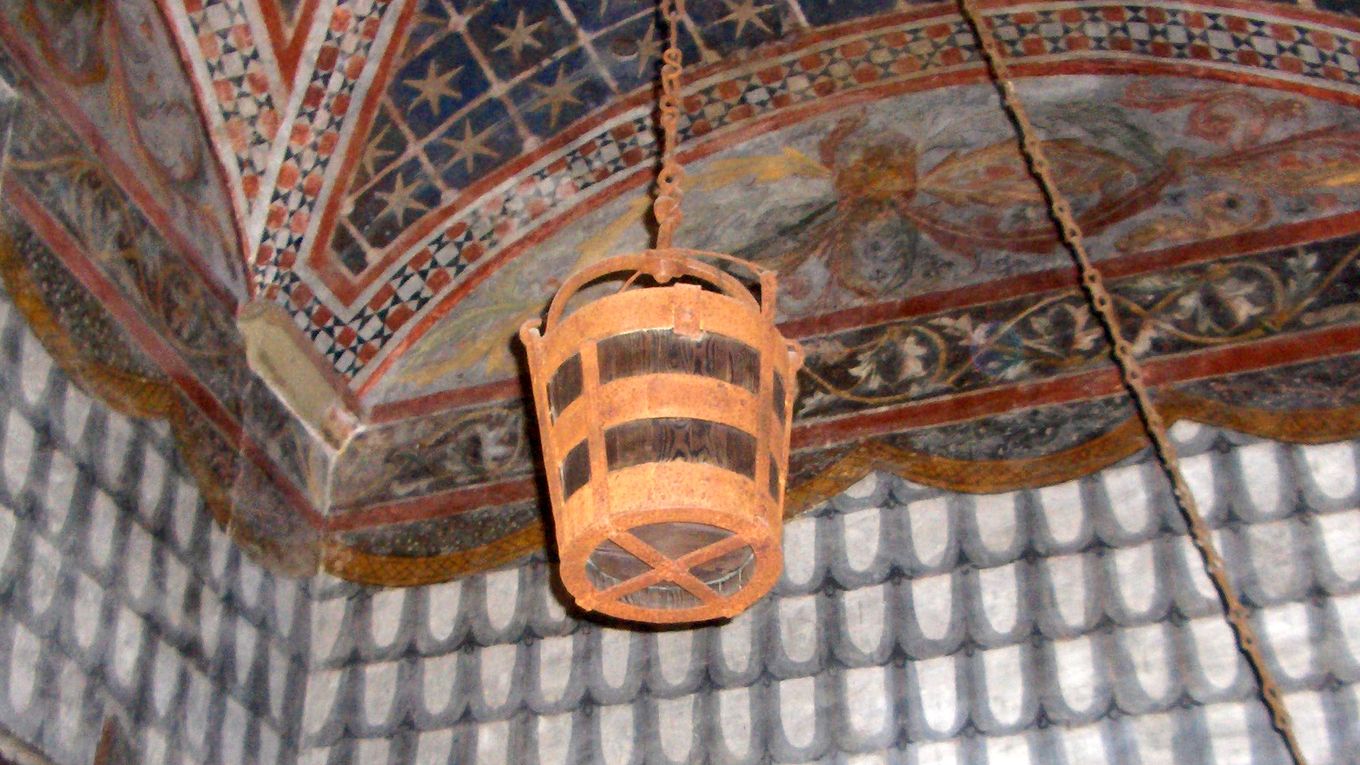

In the Palazzo Comunale, the town hall of Modena in northern Italy, there is a small, richly decorated room called the Camerino dei Confirmati. In a glass case in that room sits an old bucket of wood and iron, the kind once lowered on a rope into a public well.
Ask almost anyone in Modena or Bologna about it and they will tell you that the two cities once went to war over it: Modenese raiders stole it from a well in Bologna, the Bolognese demanded it back, and thousands of men died in the battle that followed.
The bucket is real, and so was the battle, but the story has them the wrong way around. The battle came first, and it was a slaughter. The bucket was merely the parting insult.
Neighbours and enemies
Modena and Bologna stand less than 40 kilometres apart on the old Roman road across the plain of the Po. For most of the Middle Ages they fought over the land between them, a strip of castles and villages along the rivers Panaro and Samoggia.
The two cities had old scores to settle. In 1249, at Fossalta, Bologna had beaten Modena and captured King Enzo, a son of the emperor Frederick II. The Bolognese kept Enzo prisoner in their city for the rest of his life, 23 years.
The road to Zappolino
In the summer of 1325 the Bolognese raided Modenese territory. In September the castle of Monteveglio, on Bologna’s side of the border, was betrayed to Modena, and two of its castellans were beheaded. Bologna, with allies from Florence and the Romagna, marched out to besiege it.
On paper, the Bolognese should have won easily. According to the figures usually cited, they had about 30,000 foot soldiers and 2,500 cavalry. The Modenese only fielded about 5,000 infantry and 2,800 cavalry, though many of the horsemen were German professionals.
Two hours on a November afternoon
The Modenese did not march straight at the enemy. They made as if to cross the Panaro near Marano, drawing the Bolognese away from Monteveglio, and then met them on 15 November 1325 at Zappolino, a village in the hills west of Bologna.
The Bolognese had been hurriedly recalled from Bazzano and Ponte Sant’Ambrogio, where Modenese feints had drawn them, and had little time to form up. The Modenese cavalry charged their front line, while a second body of horsemen came in on their flank.
The fighting lasted about two hours and ended around sunset. Surprised by the attack from the side, the much larger Bolognese army broke and ran. Some fugitives shut themselves in the castles of Zappolino and Oliveto. Others fled all the way back to Bologna, with the enemy not far behind them. About 2,000 Bolognese were killed and many more were taken prisoner.
Racing to the gates
The Modenese caused havoc as they chased the survivors. They wrecked the castles of Crespellano, Zola, Samoggia, Anzola, Castelfranco and Piumazzo, and the weir on the river Reno at Casalecchio, which fed Bologna’s canals and mills.
Then, outside the walls of Bologna, they held a palio, a set of traditional horse races, in full view of the city. A chronicle says it was done to keep the memory of the victory alive forever and “to the eternal shame of the Bolognese.”
Before they left, they took a souvenir. Just outside the Porta San Felice, the same western gate through which the beaten Bolognese had fled, there was a public well. The Modenese took its wooden bucket and carried it home in triumph.
A quick peace
The victory did not last long on the ground. In January 1326 peace was made, and the castles were handed back to Bologna. Twenty-six leading Bolognese captured in the campaign had been held in Modena for eleven weeks.
The bucket stayed in Modena. It was locked away in the Ghirlandina, the bell tower of the cathedral and the city’s great landmark, as a trophy.
How a trophy became a cause
Almost three centuries later, the Modenese poet Alessandro Tassoni wrote La secchia rapita, “The Stolen Bucket,” published in Paris in 1622. It is a mock epic, a comic poem that tells a petty squabble in the grand style of Homer and Virgil. In Tassoni’s version, the theft of the bucket starts the war. The Olympian gods take sides. It was never meant to be historically accurate, the battle of Fossalta, nearly eighty years earlier, is muddled in with Zappolino, and a ridiculous Modenese nobleman, the Count of Culagna, blunders through the story.
The poem was a huge success, and its plot slowly replaced the history. Many modern accounts still say that the war began when Modenese soldiers stole the bucket.
Questions and answers
Where is the bucket now?
Modena never gave it back. For centuries the bucket hung in the Ghirlandina. Today the tower displays a copy, and the original sits in the Camerino dei Confirmati in the Palazzo Comunale, a small room decorated in 1770 by Giuseppe Carbonari and Girolamo Vannulli.
Does the well still exist?
According to local historians, yes. The well outside the old Porta San Felice was never filled in, and lies under a manhole cover in the street. The gate itself still stands at the western end of Via San Felice.
Why did Tassoni turn the story upside down?
Because it was funnier. Tassoni was a sharp-tongued critic who disliked the reverence of his time for classical epic. A war of Homeric scale over a wooden bucket was the perfect way to mock the grand style, and his fellow Modenese could enjoy it at Bologna’s expense.
Did the poem have any influence outside Italy?
A great deal. La secchia rapita was one of the first and most popular mock epics of the modern age. It is usually counted among the models for Nicolas Boileau’s Le Lutrin (1674), about a quarrel over a church lectern, and for Alexander Pope’s The Rape of the Lock (1712–1714), about the theft of a lock of hair.
Key dates
- 1249
- Bologna defeats Modena at Fossalta and captures King Enzo, son of the emperor Frederick II
- July–August 1325
- Bolognese troops raid Modenese territory
- September 1325
- The castle of Monteveglio is betrayed to Modena; Bologna and its allies besiege it
- 15 November 1325
- Modena routs Bologna at Zappolino, then takes a wooden bucket from a well outside Bologna's Porta San Felice
- January 1326
- Peace is made; the captured castles go back to Bologna, but the bucket stays in Modena
- 1622
- Alessandro Tassoni publishes La secchia rapita, the comic epic that makes the bucket the cause of the war
Further reading
Armies of the Medieval Italian Wars 1125-1325
Gabriele Esposito · An illustrated guide to the armies, arms and armour of the Italian wars of this period, ending with the campaign that included Zappolino.
View on Bookshop.org: Armies of the Medieval Italian Wars 1125-1325
The Italian City Republics
Trevor Dean and Daniel Waley · A standard history of the medieval Italian city-states, covering the rivalries, wars and politics of cities like Modena and Bologna.
View on Bookshop.org: The Italian City RepublicsThis article contains affiliate links. If you buy through them, Yorewire may earn a small commission at no extra cost to you. Affiliate disclosure.
Sources
- 1'La Secchia Rapita', Sale Storiche del Palazzo Comunale, Comune di Modena (The town hall's own page on the bucket, kept in the Camerino dei Confirmati, and on the copy in the Ghirlandina.)
- 2'Ghirlandina, visita guidata dedicata alla Secchia rapita', Comune di Modena press office (2024) (Confirms the copy of the bucket displayed in the Ghirlandina tower.)
- 3'Perché hai rubato la Secchia rapita?', Gazzetta di Modena (4 March 2018) (Schoolchildren discover that the bucket in the tower is a copy and ask the mayor to see the original.)
- 4Alessandro Tassoni, La secchia rapita (1622), via the Internet Archive (The mock-epic poem that turned a war trophy into the cause of a war.)
- 5David Abulafia, 'Italy in the fourteenth century', in The New Cambridge Medieval History, vol. 6 (Cambridge University Press, 2000) (Notes that Ghibelline influence in the region was consolidated by the victory at Zappolino.)
- 6'Battaglia di Zappolino' and 'La secchia rapita', Italian Wikipedia; 'Battle of Zappolino', English Wikipedia (Used for the background, the size of the armies and the aftermath, drawing on Lenzi, La battaglia di Zappolino e la secchia rapita (2001). The Italian article gives the Bolognese dead as 'more than 2,000' in one place and 'more than three thousand' in another.)