The Butcher: The One-Eyed Constable of France
As a boy, Olivier de Clisson was shown his father's head on a spike. As a man he lost an eye fighting France, then changed sides, commanded its armies, survived two attempts to kill him and helped drive a king mad.
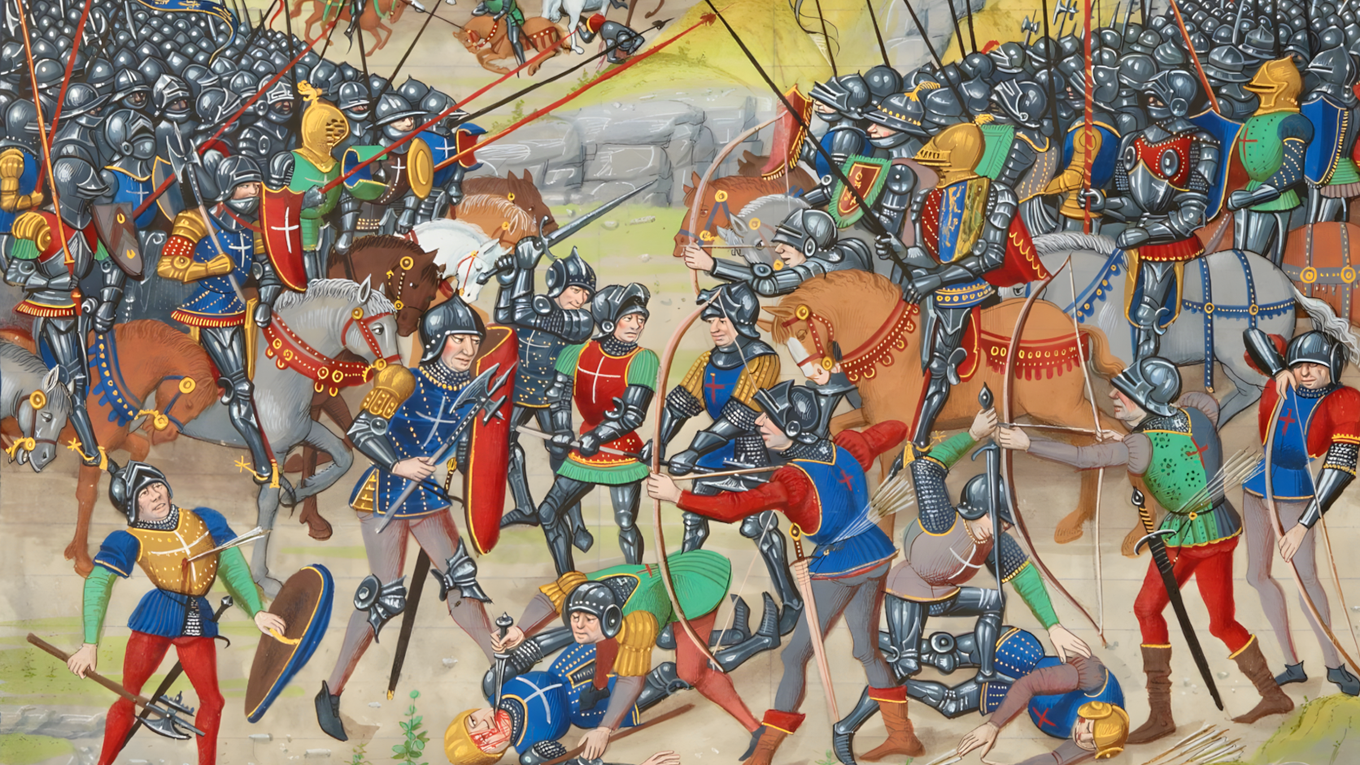

In the summer of 1343, according to tradition, a seven-year-old boy was taken to the gates of Nantes and shown a head on the end of a lance. It was his father’s. Olivier IV de Clisson had been beheaded in Paris for treason, his body hung from the great gibbet of Montfaucon, and his head sent to Brittany as a warning. The boy’s mother, Jeanne de Clisson, swore revenge and went to war at sea. The boy grew up to become one of the most feared soldiers in Europe, a man his enemies called “the Butcher.” And in a bizarre twist of fate, he ended up commanding the armies of the very kingdom that had killed his father.
A boyhood of revenge
Olivier V de Clisson was born on the 23rd of April 1336 in his family’s great castle at Clisson, which guarded the southern border of Brittany. He was seven when his father was executed for treason. His mother’s revenge turned their lives upside down. She was banished, her lands were confiscated, and she took her war to sea as an ally of the English. According to tradition, her ship was eventually sunk, and Olivier’s younger brother Guillaume died in the aftermath.
Olivier was sent to England and raised at the court of Edward III, alongside another exile, the young John de Montfort, who claimed the Duchy of Brittany. The two boys would spend the rest of their lives as allies, rivals and, eventually, deadly enemies.
The one-eyed man of Auray
Olivier came home to Brittany as a young man to fight for Montfort in the long war over the duchy. The decisive battle came at Auray, on the 29th of September 1364. Montfort’s army, stiffened by English troops under the veteran commander John Chandos, faced the French-backed army of Charles de Blois and the great Breton soldier Bertrand du Guesclin.
Olivier commanded one of Montfort’s divisions and fought so hard that the chroniclers singled him out. At some point in the fighting, he was struck in the face and lost an eye, but he stayed in the field. Montfort’s army won. Charles de Blois was killed in the mêlée, and du Guesclin was taken prisoner. The war over Brittany was over, and Olivier had earned a new nickname: “the one-eyed man of Auray.”
Changing sides
Victory did not bring him the rewards he wanted. When the new duke gave the castle of Gâvre, which Olivier coveted, to the Englishman Chandos, Olivier is said to have raged that he would “rather give myself to the devil than have an English neighbour.” Soon afterwards, the castle burned down.
Over the next few years he drifted away from the duke and towards the King of France, Charles V, who showered him with lands and money. By around 1370 he had changed sides completely. He swore an oath of brotherhood-in-arms with du Guesclin, the man he had fought at Auray, and together they began driving the English out of western France.
“The Butcher”
The war in western France in the 1370s was vicious on both sides. The English often spared only those prisoners rich enough to pay a ransom. According to his modern French biographer Philippe Richard, when one of Olivier’s squires was captured and tortured to death at Benon, near La Rochelle, in 1372, Olivier took the castle and executed fifteen English prisoners with his own hands. He was also said not to hesitate to mutilate his captives, hacking off an arm or a leg. Du Guesclin himself supposedly remarked, “By the body of Saint Benedict, the English are not wrong when they call you the Butcher!” Even the historian Georges Minois has called him “a bloodthirsty maniac,” though he points out that to writers of the time, cruelty in war was more a virtue than a crime.
Constable of France
When du Guesclin died in 1380, the new king, Charles VI, was just twelve years old. On the 28th of November 1380 he appointed Olivier Constable of France, the supreme commander of the royal army. The man whose father had been executed as a traitor to France now held its highest military office.
Two years later he proved his worth. In 1382 the weavers and merchants of Ghent rose in revolt against their count, and the French went to crush them. On the 27th of November the two armies met at Roosebeke. The Flemish advanced in a dense mass, their pikes held up so thickly they “had the appearance of a wood.” The French men-at-arms closed in on both flanks and squeezed the Flemish together until they “could not use their staves to defend themselves.” Men “lost both strength and breath, and, falling upon one another, were stifled to death without striking a blow.” Then the killing began. The French “cut through helmets and disbrained heads” with battle-axes and leaden maces, and the camp followers moved among the fallen with long knives, finishing off the wounded “without more mercy than if they had been so many dogs.”
Froissart puts the Flemish dead at nine thousand on the field and many thousands more in the pursuit, and says “so little blood” was spilled because so many had simply been crushed to death. The battle lasted half an hour. The next day the king moved his camp, “on account of the stench of the dead.”
Betrayed by his friend
One of the greatest enemies of France was now Olivier’s boyhood companion, John de Montfort, Duke of Brittany. In June 1387 the duke invited Olivier to a parliament at Vannes and, after a friendly dinner, asked him to inspect his new Castle of the Ermine. “There is not a man on this side of the sea who understands masonry like you,” the duke told him, and he asked Olivier to go into the keep alone and check the walls.
When Olivier climbed the stairs, armed men hidden inside shut the door behind him, seized him and loaded him with three pairs of fetters. According to Froissart, the duke wavered through the night between having him beheaded and having him drowned. Three times Olivier’s fetters were struck off so that he could be taken out to die. A later Breton history says the duke finally ordered a knight named John de Bazvalen to kill him in secret. In the morning, overcome with remorse, the duke asked whether it had been done. Bazvalen told him Olivier had been drowned in the night. Only when the duke fell into despair did Bazvalen admit he had disobeyed the order. Olivier bought his freedom with a huge ransom and several of his castles.
Ambush in Paris
Five years later, someone tried to kill him again. On the night of the 13th of June 1392, Olivier left a royal feast at the Hôtel Saint-Pol in Paris after midnight and rode home down the rue Sainte-Catherine with a few servants carrying torches. A disgraced nobleman, Pierre de Craon, was waiting in the dark with a band of armed men.
Craon’s men rode up and put out the torches. Olivier, hearing horses behind him, thought it was the king’s brother playing a joke. Then Craon drew his sword and shouted, “Death, death! Clisson, you must die.” Olivier had no armour, only a short blade “not two feet long,” and he fought back from the saddle until a blow to the back of his head knocked him off his horse. He fell against the half-opened door of a baker who was up early to bake the day’s bread, burst through it and rolled into the shop. The horsemen could not follow him through the narrow doorway. Believing he could never recover from that last blow, “given by a lusty arm,” Craon fled Paris.
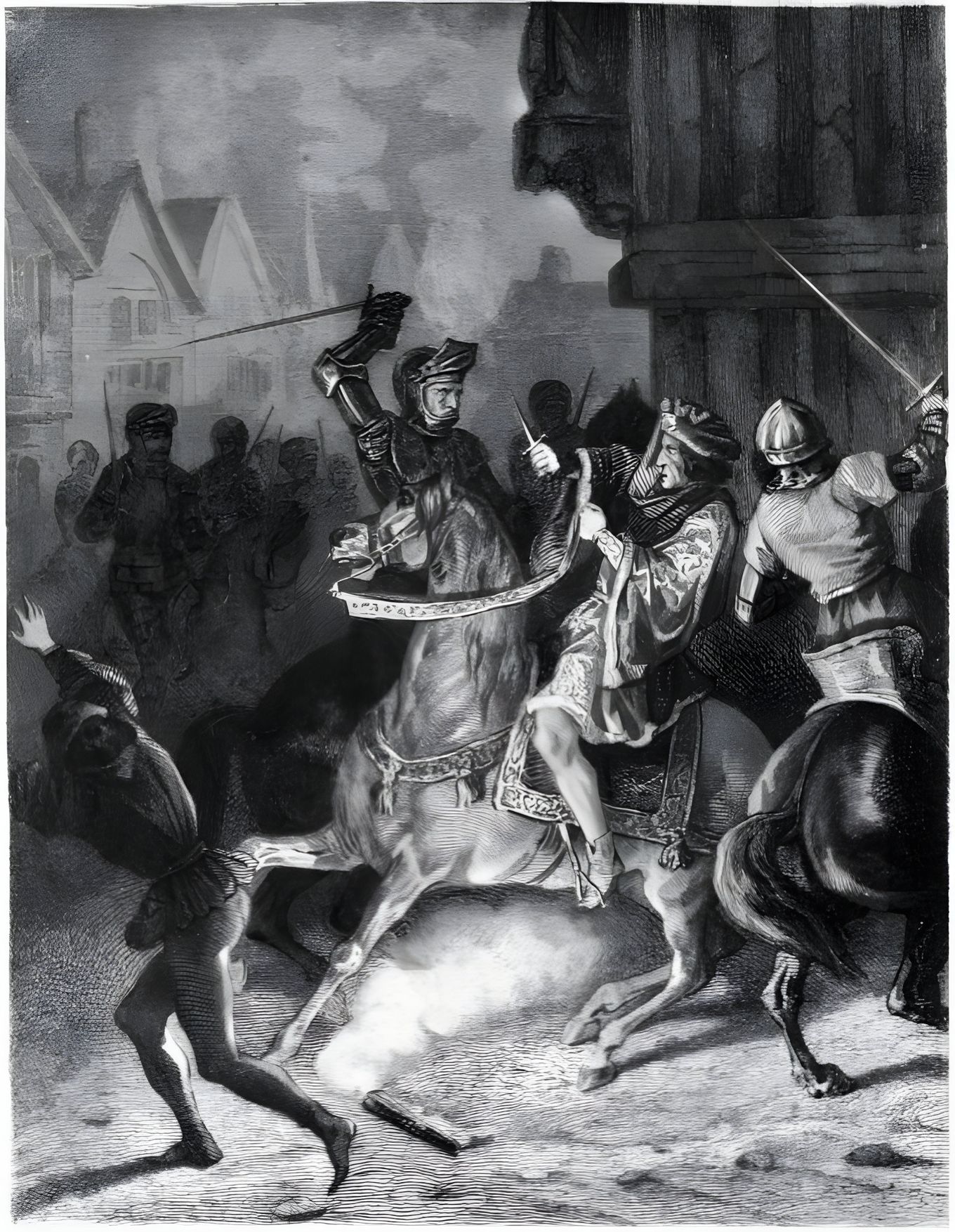

The king came to the baker’s shop in the middle of the night in his cloak and slippers and found his Constable covered in blood but alive. “Constable,” he promised him, “nothing shall ever be more severely punished than this crime.”
The king goes mad
Craon had fled to the Duke of Brittany, and Charles VI resolved to punish the duke. In August 1392 he marched west with his army, with Olivier at his side. The king had been ill and feverish all summer. In the forest near Le Mans, a barefoot, bareheaded man rushed out from the trees, seized the reins of the king’s horse and cried: “King, ride no further, but return, for thou art betrayed.”
A little later, in the blazing heat of the open plain, a drowsy page dropped a lance onto another page’s helmet with a loud clang. The king, startled, drew his sword and attacked the men around him, shouting “Advance! Advance on these traitors!” He chased his own brother, lashing out at anyone who came near, until his knights wore him down and a chamberlain caught him from behind. The king of France had gone mad, and he would suffer bouts of madness for the rest of his life.
The campaign against Brittany was abandoned, and Olivier’s enemies at court, led by the king’s uncles, blamed him. On the 10th of December 1392 the Parlement of Paris condemned him as a “false traitor” for illegally enriching himself, banished him from the kingdom and ordered him to pay two hundred thousand livres. He refused to give back the Constable’s sword and withdrew to his fortress at Josselin in Brittany.
The richest man in Brittany
Olivier had made himself enormously rich. The historian Yvonig Gicquel estimated that, by around 1400, his fortune was worth six tonnes of gold and sixty tonnes of silver, which would make him one of the richest men of his age. He made peace with the Duke of Brittany in 1396, after thirty years of feuding, and the two old enemies stayed at peace until the duke died in 1399.
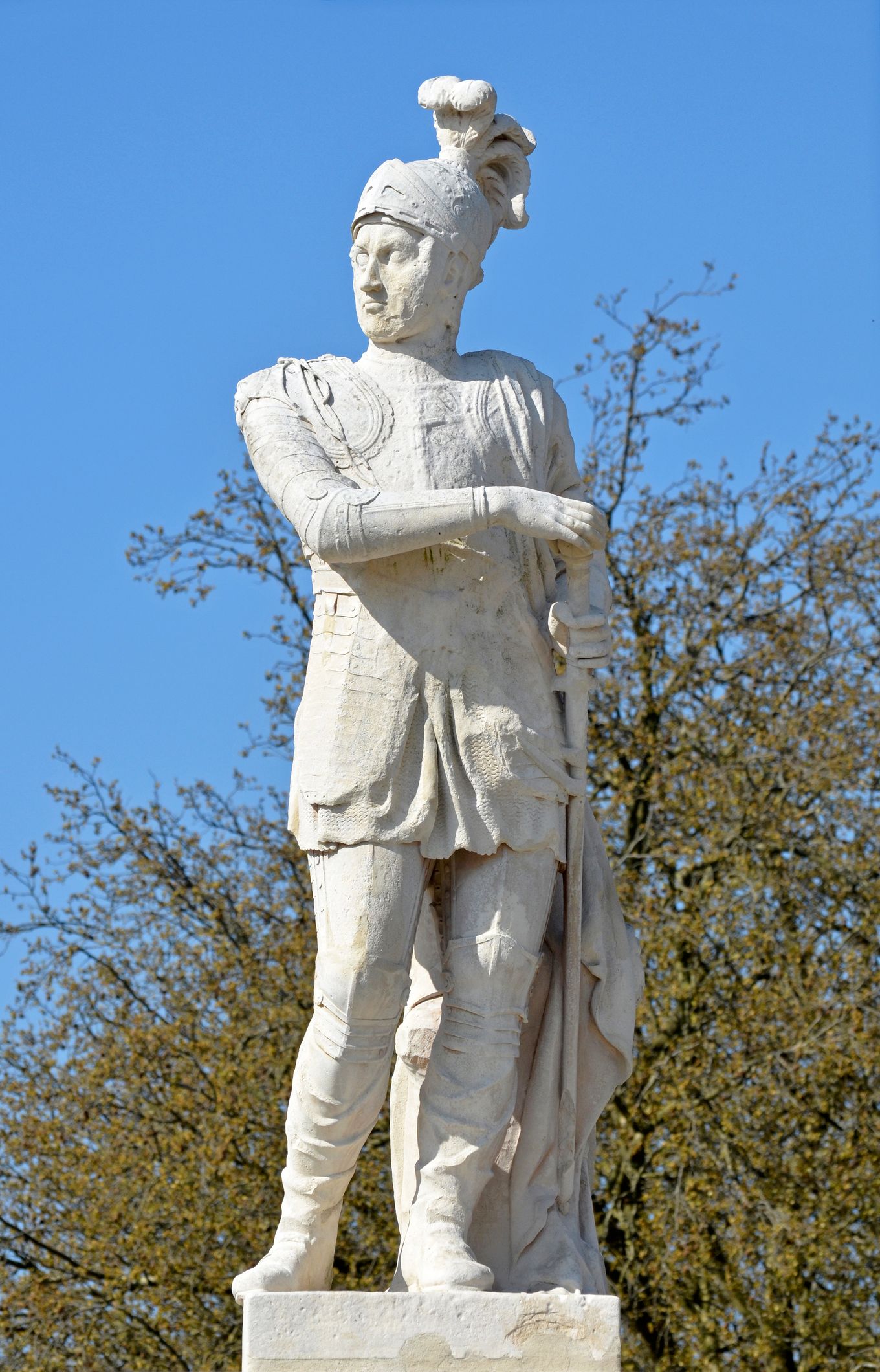
Olivier de Clisson died at Josselin on the 23rd of April 1407, his seventy-first birthday. In his will he asked that the Constable’s sword, which he had never given back, finally be returned to the king. He was buried in the chapel of the castle at Josselin, but even in death he was not left in peace: his tomb was desecrated during the French Revolution in 1793.

Questions and answers
Why was Olivier de Clisson called “the Butcher”?
He had a reputation for exceptional cruelty in war, including killing and mutilating prisoners. According to his biographer Philippe Richard, the name stuck after he executed fifteen English prisoners with his own hands at Benon in 1372 in revenge for the torture and murder of his squire.
How did he lose his eye?
He was wounded in the face at the Battle of Auray in 1364 while fighting for John de Montfort against the French-backed Charles de Blois. He kept fighting despite the wound, and the battle ended the war over Brittany in Montfort’s favour.
Why did he fight for France after it killed his father?
The Treaty of Brétigny in 1360 restored his father’s honour, and by the late 1360s Olivier had fallen out with the Duke of Brittany. The King of France, Charles V, offered him lands and money, and by around 1370 he had joined the French side. Changing sides in this way was not unusual among the great lords of the age.
Key dates
- 23 April 1336
- Olivier de Clisson is born at the Château de Clisson, son of Olivier IV de Clisson and Jeanne de Belleville
- 2 August 1343
- His father is beheaded in Paris for treason; his mother turns to raiding at sea
- c. 1345–1359
- Olivier is raised in England, at the court of Edward III
- 29 September 1364
- He loses an eye at the Battle of Auray, which wins Brittany for John de Montfort
- c. 1370
- Olivier changes sides and joins Bertrand du Guesclin in the service of Charles V of France
- 28 November 1380
- He is made Constable of France
- 27 November 1382
- He leads the French army that slaughters the Flemish rebels at Roosebeke
- June 1387
- The Duke of Brittany seizes him at the Castle of the Ermine and orders his death
- 13–14 June 1392
- Pierre de Craon tries to murder him in the streets of Paris
- August 1392
- Charles VI goes mad on the march to punish Brittany; Olivier falls from power
- 23 April 1407
- Olivier dies at Josselin on his 71st birthday
Further reading
The Hundred Years War, Volume 2: Trial by Fire
Jonathan Sumption · Covers the mid-14th-century Hundred Years War, including the 1364 Battle of Auray where Olivier de Clisson lost an eye.
View on Bookshop.org: The Hundred Years War, Volume 2: Trial by Fire
The Hundred Years War, Volume 3: Divided Houses
Jonathan Sumption · Covers the period of Olivier de Clisson's tenure as Constable of France in the 1380s and 1390s.
View on Bookshop.org: The Hundred Years War, Volume 3: Divided HousesThis article contains affiliate links. If you buy through them, Yorewire may earn a small commission at no extra cost to you. Affiliate disclosure.
Sources
- 1Jean Froissart, Chronicles of England, France, Spain, and the Adjoining Countries, trans. Thomas Johnes (London, 1848), vol. 2 (The contemporary chronicler's accounts of Olivier's arrest at the Castle of the Ermine, Pierre de Craon's attack and the madness of Charles VI.)
- 2Jean Froissart, Chronicles, trans. Thomas Johnes (London, 1848), vol. 1 (Froissart's accounts of the Battle of Roosebeke and the storming of Benon.)
- 3Chronique normande du XIVe siècle, ed. Auguste and Émile Molinier (Paris, 1882) (Fourteenth-century chronicle recording the execution of Olivier's father and the display of his head at Nantes.)
- 4'Olivier V de Clisson', Wikipédia (French) (Detailed article drawing on the biographies by John Bell Henneman (1996), Yvonig Gicquel (1981) and Philippe Richard (2007); used for the Benon episode, his wealth and historians' verdicts.)
- 5'Olivier V de Clisson', Wikipedia (Used for his early life and career; contains some errors, including a mis-dated Battle of Auray, and is not relied on where it conflicts with Froissart.)