The Town That Fought the Romans With Bears and Bees
In the winter of 73–72 BC, a Roman army besieging the town of Themiskyra, legendary home of the Amazons, dug tunnels under its walls. The defenders dug down to meet them, and then released bears, wild animals and swarms of bees into the dark.
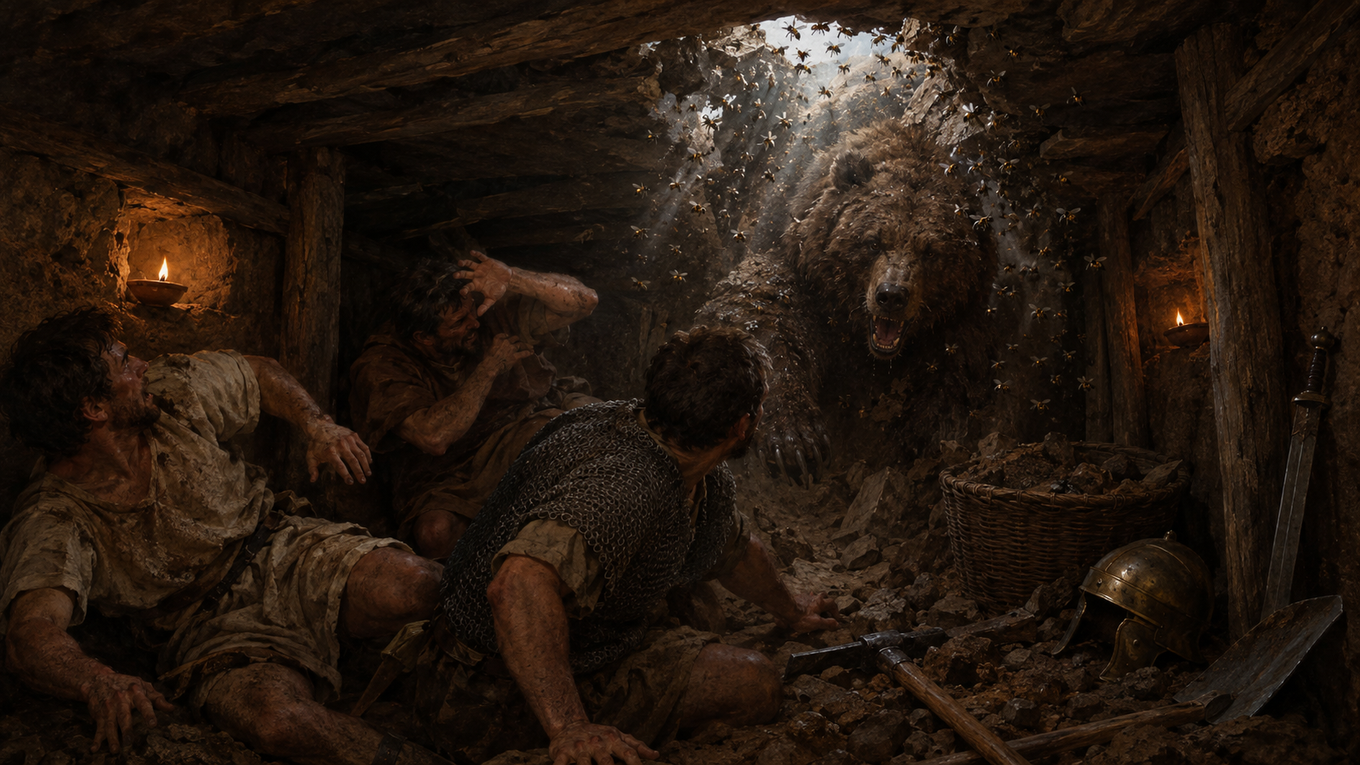
In the winter of 73–72 BC, a group of Roman legionaries were deep beneath the walls of a town on the Black Sea coast, hacking at the earth so that the wall above would collapse when the tunnel’s timber props were burned. Suddenly the earth broke open above them and something heavy dropped through the hole into the dark. It was a bear.
That, more or less, is what the Greek historian Appian says happened at Themiskyra, in what is now northern Turkey. When a Roman army dug under the town’s walls, the defenders “cut openings into these tunnels from above and thrust bears and other wild animals and swarms of bees into them against the workers.”
The Amazons’ city
Themiskyra stood on the plain where the river Thermodon flows into the Black Sea, probably near the modern Turkish town of Terme. To the Greeks it was a place of legend. It was said to be the capital of the Amazons, the warrior women of myth, and the place where Heracles came to take the girdle of their queen, Hippolyta, as one of his twelve labours.
By the first century BC it belonged to a very real and very dangerous king: Mithridates VI of Pontus. For a quarter of a century Mithridates had been Rome’s most stubborn enemy. In 88 BC he had overrun Rome’s province in Asia Minor and ordered the massacre of the Romans and Italians living there. Rome had fought two wars to bring him down and failed.
In 74 BC the third war began. The Roman general Lucius Licinius Lucullus caught Mithridates besieging the city of Cyzicus, trapped his army there and destroyed it through hunger and disease. Mithridates fled home to Pontus, and Lucullus followed him.
Tunnels big enough for battles
That winter, Lucullus laid siege to the great Pontic port of Amisus and the neighbouring royal city of Eupatoria. He sent another army against Themiskyra.
Appian says the Romans attacked Themiskyra with everything they had. They “brought up towers, built mounds, and dug tunnels so large that great subterranean battles could be fought in them.” Undermining was one of the most effective ways to bring down a city wall in the ancient world. Attackers dug a tunnel to the foundations, propped up the roof with timber as they went, then set the timbers on fire. When the props burned through, the tunnel collapsed, and with luck the wall above it collapsed too.
Defenders had an answer: the countermine. If they could work out where the enemy were digging, they dug their own tunnel down to meet them, then broke in to fight, flood or smoke them out.
The people of Themiskyra did something more inventive. They broke into the Roman tunnels from above, and instead of soldiers, they sent down animals. Appian mentions bears, “other wild animals,” and swarms of bees.
The horror in the dark
Appian does not describe what happened next, but it is not hard to imagine. A Roman tunnel was a cramped, airless space badly lit by smokey lamps, where men could barely see or turn around. A frightened, furious bear dropped into it would have been terrifying. So would a swarm of angry bees: in a tunnel there was nowhere to run and no fresh air to escape into.
The countryside around Themiskyra could easily supply the animals. The geographer Strabo, writing a few decades later, described the plain of Themiskyra as wonderfully fertile. Its forests were so full of wild fruit that anyone could go out and gather it at any time of year, and “numerous, also, are the catches of all kinds of wild animals, because of the good yield of food.”
What happened next
Appian does not say. His account moves straight on to the siege of Amisus, where the defenders fought back with frequent sallies and challenges to single combat, and then to Lucullus’s spring campaign against Mithridates himself. We do not know whether Themiskyra fell, surrendered or simply outlasted the Romans until the war moved on.
The war certainly did. In 72 BC Lucullus marched inland against Mithridates, who had raised a new army of about 40,000 men at Cabira. Mithridates’ army collapsed, and the king fled to his son-in-law, Tigranes of Armenia. Amisus eventually fell to the Romans, and Lucullus, who admired its Greek origins, gave it back its freedom. Mithridates himself kept fighting for another decade. Driven out of his kingdom by Pompey, he died in 63 BC in the Crimea, facing a revolt led by his own son.
Questions and answers
Was this a one-off, or did other defenders use animals against tunnellers?
It was a known tactic. Aeneas Tacticus, a Greek general who wrote a handbook on surviving sieges around 350 BC, nearly three centuries before Themiskyra, advises defenders to dig a ditch to intercept enemy tunnels, set fire to rubbish in it so the smoke pours into the tunnel and “injure[s] those in the mine,” and adds: “in some instances, by releasing wasps and bees into the opening, men have worked mischief with those in the mine.” What made Themiskyra unusual was the bears.
Were bees used as weapons anywhere else in this war?
In a way, yes, through their honey. The mountains of Pontus produce “mad honey,” made from the nectar of certain rhododendrons and containing toxins that cause vomiting, dizziness and delirium. In 401 BC the Greek general Xenophon described how his soldiers ate it on the Black Sea coast and collapsed as if drunk. In 65 BC, according to Strabo, a mountain tribe called the Heptakometai left bowls of this “crazing honey” on the road in front of Pompey’s army. When the Roman soldiers drank it and lost their senses, the tribesmen attacked and wiped out three maniples, several hundred men. Some modern accounts credit Mithridates himself with the trap, but Strabo does not.
Did the Amazons really live at Themiskyra?
Not as far as anyone can tell. The Amazons were a legend, though one the Greeks took very seriously. Herodotus, writing in the fifth century BC, connects them with Themiskyra, and the town appears in the stories of Heracles and of Jason and the Argonauts. Nothing like an Amazon city has ever been found there.
Can you visit Themiskyra today?
Not really. Its exact site is unknown, and no ruins have been identified. It probably lay close to the modern town of Terme, in Samsun Province in northern Turkey, which today has a statue of an Amazon warrior to mark the connection.
Key dates
- 88 BC
- Mithridates VI of Pontus overruns Roman Asia; the First Mithridatic War begins
- 74–73 BC
- The Third Mithridatic War begins; Lucullus defeats Mithridates at Cyzicus and pursues him into Pontus
- Winter 73–72 BC
- Lucullus besieges Amisus, Eupatoria and Themiskyra; the defenders of Themiskyra release bears, wild animals and bees into the Roman tunnels
- Spring 72 BC
- Lucullus marches inland against Mithridates at Cabira
- 65 BC
- In the mountains of Pontus, a local tribe poisons three maniples of Pompey's army with 'mad honey'
Further reading
Mithridates the Great: Rome's Indomitable Enemy
Philip Matyszak · A biography of Mithridates VI of Pontus, the king whose war with Rome brought the siege of Themiskyra.
View on Bookshop.org: Mithridates the Great: Rome's Indomitable EnemyThis article contains affiliate links. If you buy through them, Yorewire may earn a small commission at no extra cost to you. Affiliate disclosure.
Sources
- 1Appian, The Mithridatic Wars, chapter 78, trans. Horace White (Loeb Classical Library, 1912), via Livius.org (The only ancient account of the bears and bees at Themiskyra, written by a Greek historian in the second century AD.)
- 2Aeneas Tacticus, On the Defence of Fortified Positions, chapter 37, trans. Illinois Greek Club (Loeb Classical Library, 1923), via LacusCurtius (A Greek siege manual of the fourth century BC that recommends smoke, wasps and bees against enemy tunnellers.)
- 3Strabo, Geography, book 12, chapter 3, trans. H. L. Jones (Loeb Classical Library, 1928), via LacusCurtius (Describes the plain of Themiskyra and its abundant game, and the 'crazing honey' used against Pompey's army.)
- 4'Themiscyra (Pontus)', 'Third Mithridatic War' and 'Mad honey', Wikipedia (Used for the myths of Themiskyra, the course of the war and the history of mad honey.)