'Those About to Die Salute You': The Battle on Lake Fucinus
To celebrate a drainage tunnel, the Emperor Claudius staged the largest mock sea battle Rome had ever seen: 19,000 condemned prisoners, real warships and a silver Triton rising from the water. When the doomed men saluted him, he gave an answer they misunderstood, and it nearly ended in a massacre.
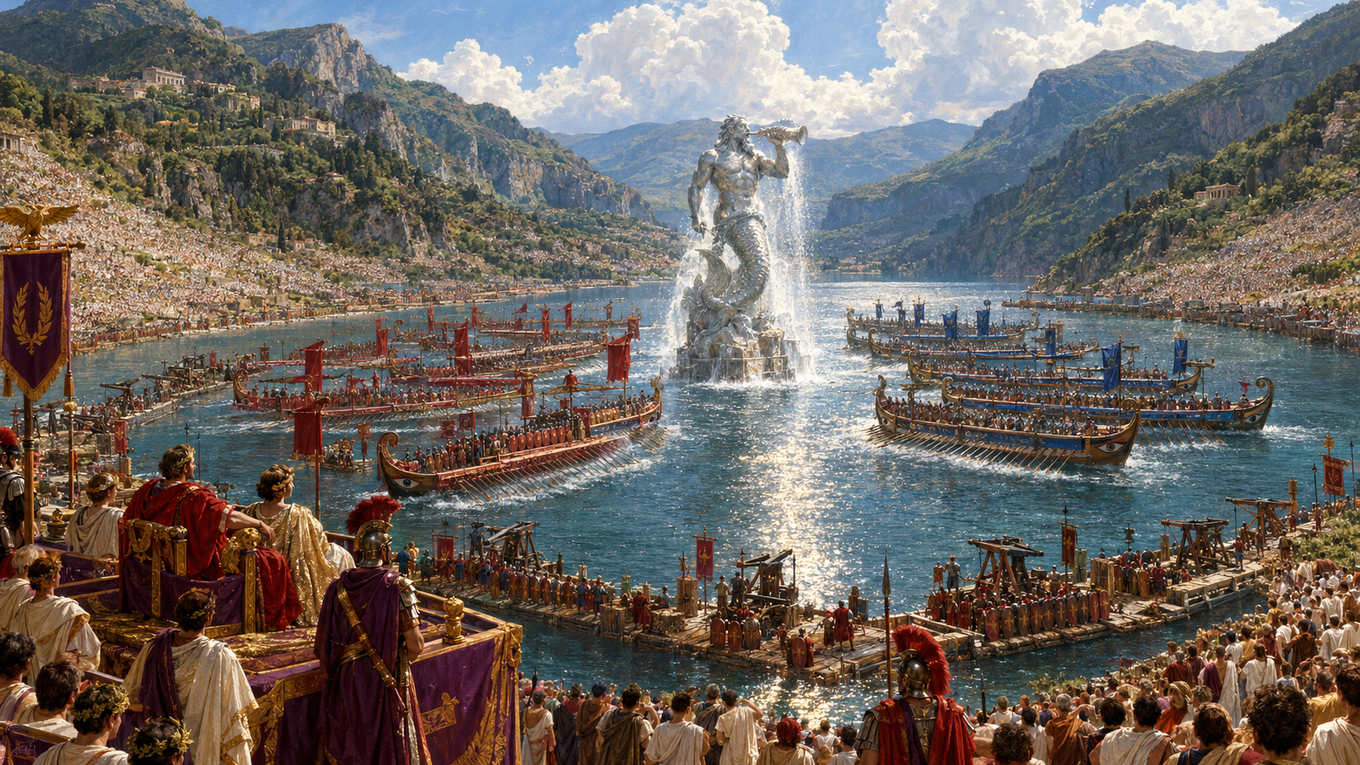
In AD 52, on the shores of a mountain lake east of Rome, tens of thousands of spectators packed the slopes as if they were seats in a theatre. Out on the water, two fleets of real warships waited, crewed by 19,000 men who had been condemned to death. Around the edge of the lake, a ring of rafts carried soldiers of the Praetorian Guard, their catapults loaded, ready to shoot down anyone who tried to escape. Then, from the middle of the lake, a silver statue of the sea god Triton rose up out of the water, raised its horn and blew the signal to begin.
It was the largest naval spectacle the Roman world had ever seen. Before it could start, it very nearly turned into a massacre.
An unwanted lake
The Fucine Lake, high in the Apennine mountains east of Rome, in what is now Abruzzo, was one of the largest lakes in Italy. It had no natural outlet, so its level rose and fell unpredictably, drowning the fields of the Marsi people who farmed its shores. For years they had begged Rome to drain it. The emperor Augustus refused. Claudius, who became emperor in AD 41, said yes.
Suetonius says he took on the job “as much in the hope of gain as of glory,” since some investors had offered to pay for it if they could keep the land it exposed. His engineers dug a tunnel about three Roman miles (roughly six kilometres) long through Mount Salviano to carry the lake’s water into the river Liris. According to Suetonius, thirty thousand men worked on it non-stop for eleven years. It was one of the greatest engineering projects of the ancient world, and Claudius wanted everyone to see it.
The show
To draw a crowd, Claudius decided to stage a naumachia, a mock sea battle, on the lake itself. Julius Caesar and Augustus had both put on naval battles in Rome, but in specially dug basins and on a much smaller scale. Claudius’s would be fought on open water, with real warships.
Tacitus says he fitted out galleys with three and four banks of oars and crewed them with nineteen thousand men. Suetonius says there were twelve triremes on each side; Cassius Dio, writing later, says fifty ships each. The two fleets were dressed up as historic sea powers, the “Rhodians” and the “Sicilians.” Every man aboard was a condemned criminal.
There was to be no way out. Claudius “lined the circumference of the lake with rafts, that there might be no means of escape,” while still leaving enough open water for the ships to manoeuvre, ram and board each other properly. “On the raft stood companies of the praetorian cohorts and cavalry, with a breastwork in front of them, from which catapults and balistas might be worked.” More marines waited on decked ships to deal with anyone who broke away.
The crowd was enormous. People came from the nearby towns and all the way from Rome, and they “crowded the banks, the hills, and mountain tops, which thus resembled a theatre.” Claudius presided in a splendid military cloak. Beside him sat his wife Agrippina in a mantle woven with gold thread, and, according to Dio, her fourteen-year-old son, the future emperor Nero.
“Those who are about to die”
Before the battle began, the condemned men gathered in front of the emperor and called out a greeting that has echoed down the centuries. Suetonius gives it in Latin: Ave imperator, morituri te salutant, “Hail, emperor, those who are about to die salute you.”
Claudius answered, “Aut non,” “Or not.”
It may have been a joke or a sour remark. The prisoners took it as a pardon. If they were not going to die, they would not fight, and they refused to start. Dio says that when they were ordered to fight anyway, they sailed through each other’s lines, “injuring each other as little as possible.”
For the emperor, it was a disaster in front of the largest audience of his reign. Suetonius says Claudius “hesitated for some time about destroying them all with fire and sword,” which would have meant turning the catapults on the ships and slaughtering 19,000 men. Instead, he leapt from his throne and ran along the edge of the lake “with his ridiculous tottering gait,” shouting threats and promises until the prisoners agreed to fight.
The battle
Then the silver Triton rose from the lake on a hidden machine and sounded its horn, and the two fleets closed.
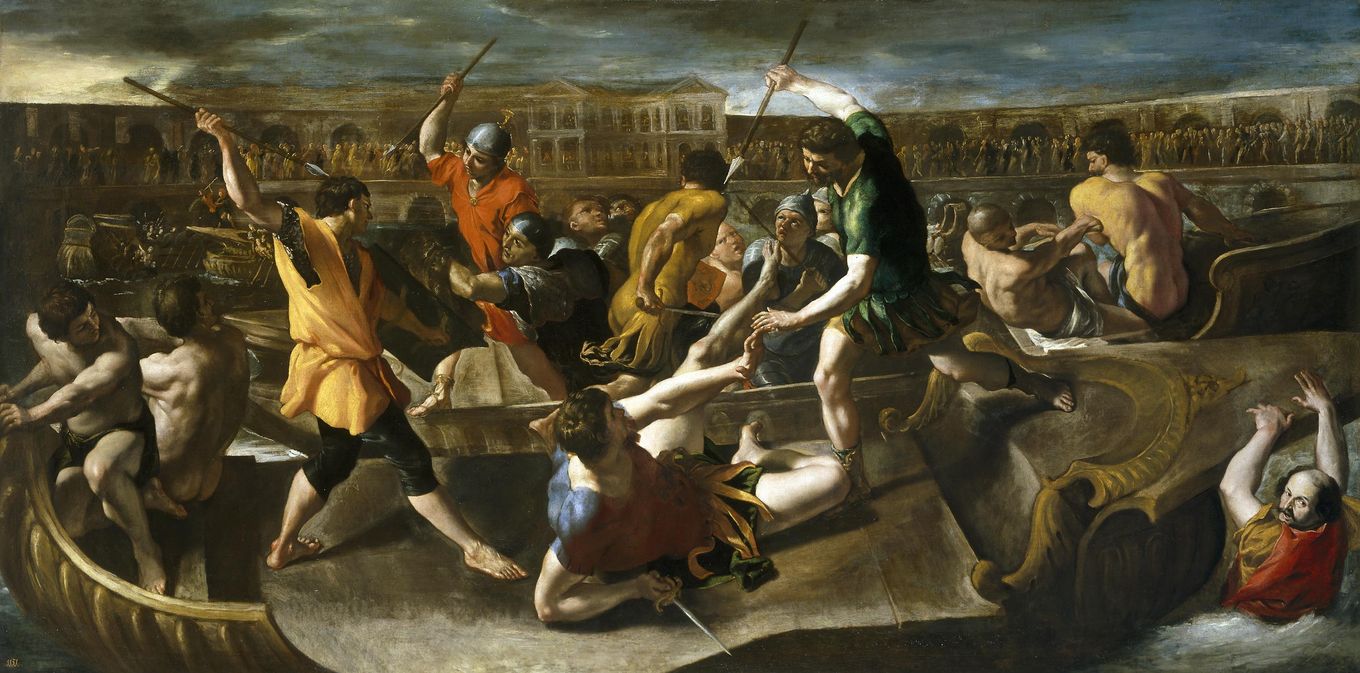

Tacitus admits that the men “fought with all the courage of brave men, though it was between condemned criminals.” Dio says the half-hearted sailing continued “until they were forced to destroy one another.” Ancient sea battles were brutal: ships rammed and holed each other, crews boarded with swords, and men who went into the water in armour drowned. None of the writers says how many died, but Tacitus says there was “much bloodshed” before the emperor called a halt and the survivors “were released from the necessity of mutual slaughter.”
Failed to drain
The battle was only the opening act. When it was over, the gates of Claudius’s great tunnel were opened, and the crowd waited for the lake to drain away.
Nothing happened. The tunnel, Tacitus says, had not been “bored down so low as the bottom, or middle of the lake,” so the water barely moved. It was an embarrassing failure in front of tens of thousands of people.
The engineers went back to work and deepened the channel. To bring the crowds back for a second attempt, Claudius put on a gladiator show on floating pontoons and laid on a lavish banquet right beside the tunnel mouth. This time it worked better than expected. The water came out all at once and “swept away the adjoining parts, shook the more remote, and spread terror with the tremendous crash.” Suetonius says Claudius himself “was well-nigh drowned.”
Agrippina seized her chance. In front of the shaken emperor, she accused his powerful freedman Narcissus, who had been in charge of the project, of pocketing the money. Narcissus shot back with an attack on her “domineering temper” and “extravagant ambition.” Dio adds that people believed Narcissus had spent far less than he had been given and had deliberately caused the collapse to hide his theft.
Questions and answers
Did gladiators really say “We who are about to die salute you”?
Probably not as a rule. Despite its fame, the phrase appears only in the accounts of this one event, in Suetonius and Cassius Dio; Tacitus describes the battle but does not mention it. There is no evidence that gladiators routinely greeted the emperor this way. Historians think it was more likely a one-off appeal by desperate men hoping for mercy. Even Claudius’s reply is uncertain: some manuscripts of Suetonius have him say “Avete vos,” “Farewell to you,” which would explain even better why the prisoners thought they had been pardoned.
Was this the biggest mock sea battle Rome ever staged?
As far as we know, yes. Julius Caesar’s naumachia in 46 BC used about 2,000 fighters and 4,000 rowers, and Augustus boasted that about 3,000 men fought in his in 2 BC. Claudius’s 19,000 dwarfed both. Later emperors staged naval battles in flooded amphitheatres, including the Colosseum, but these were far smaller.
What happened to Narcissus?
He did not long survive his master. Claudius died in AD 54, poisoned on Agrippina’s orders according to the ancient historians, and her son Nero became emperor. Narcissus was thrown into prison, and Tacitus says he “was driven to suicide by his cruel imprisonment and hopeless plight.”
Did Claudius ever drain the lake?
Only partly, and not for long. The tunnel lowered the lake, but it needed constant maintenance. Nero neglected it, and Trajan and Hadrian had to clear blockages. After the fall of the Roman Empire, and an earthquake in AD 508, it silted up and the lake returned. It was not drained for good until the nineteenth century, when Prince Alessandro Torlonia rebuilt the drainage system largely along the line of Claudius’s tunnel, and the lake was finally gone by 1878. The lake bed is now one of the most fertile farming plains in Italy, known for its potatoes and carrots.
Can you still see Claudius’s tunnel?
Yes. The Cunicoli di Claudio, the Tunnels of Claudius, near Avezzano in Abruzzo, have been an Italian national monument since 1902, and an archaeological park was created around them in 1977. Original Roman stonework survives at the entrances, and the vertical shafts the Romans dug to excavate the tunnel, some more than a hundred metres deep, can still be traced across the hillside.
Key dates
- 46 BC
- Julius Caesar stages Rome's first known naumachia, a mock sea battle, in a basin dug beside the Tiber
- 2 BC
- Augustus stages a naumachia in a purpose-built basin across the Tiber, with about 3,000 fighters
- AD 41
- Claudius becomes emperor and begins a tunnel to drain the Fucine Lake into the river Liris
- AD 52
- The tunnel is finished; Claudius celebrates with a naval battle on the lake fought by 19,000 condemned men
- AD 52
- The tunnel fails; when it is reopened, the flood nearly sweeps away the emperor's banquet
- AD 54
- Claudius dies; his freedman Narcissus, blamed for the tunnel, is driven to suicide
- 1878
- Prince Alessandro Torlonia completes the draining of the Fucine Lake, largely following Claudius's tunnel
Further reading

Claudius
Barbara Levick · A scholarly biography of the emperor Claudius, covering the Fucine Lake project and the naval battle staged to mark it.
View on Bookshop.org: Claudius
The Annals: The Reigns of Tiberius, Claudius, and Nero
Cornelius Tacitus · The primary source for the Fucine Lake naval battle, translated into English, covering Tacitus's full account of the reigns of Tiberius, Claudius and Nero.
View on Bookshop.org: The Annals: The Reigns of Tiberius, Claudius, and Nero
Spectacle in the Roman World
Hazel Dodge · A survey of Roman public spectacle, including a chapter on naumachiae, the staged naval battles of which Claudius's was the largest.
View on Bookshop.org: Spectacle in the Roman WorldThis article contains affiliate links. If you buy through them, Yorewire may earn a small commission at no extra cost to you. Affiliate disclosure.
Sources
- 1Tacitus, Annals, book 12, chapters 56–57, trans. Alfred John Church and William Jackson Brodribb (1876) (The most detailed account of the arrangements for the battle and the failure of the tunnel.)
- 2Suetonius, Life of Claudius, chapters 20, 21 and 32, trans. J. C. Rolfe (Loeb Classical Library, 1914) (Source of the famous salute, Claudius's reply, the silver Triton and the emperor's own near-drowning.)
- 3Cassius Dio, Roman History, book 60 (61), chapter 33, trans. Earnest Cary (Loeb Classical Library, 1924) (Third ancient account, giving fifty ships a side and describing the prisoners' attempt to avoid killing each other.)
- 4Tacitus, Annals, book 13, chapter 1, trans. Church and Brodribb (1876) (Records the fate of Narcissus after Claudius's death.)
- 5'Ave Imperator, morituri te salutant', 'Naumachia', 'Fucine Lake' and 'Tunnels of Claudius', Wikipedia (Used for the history of the phrase and its manuscript readings, earlier naumachiae, and the later history of the lake and tunnel.)