The Myths of the Stone That Foretells London's Fall
For over 900 years a lump of limestone has stood on what is now Cannon Street in the City of London. A rebel leader struck it with his sword and declared himself lord of the city. Later writers called it a Druid altar, a Roman milestone and the talisman that keeps London safe. Until 2016 it sat in the wall of a branch of WHSmith, hidden behind the magazines.

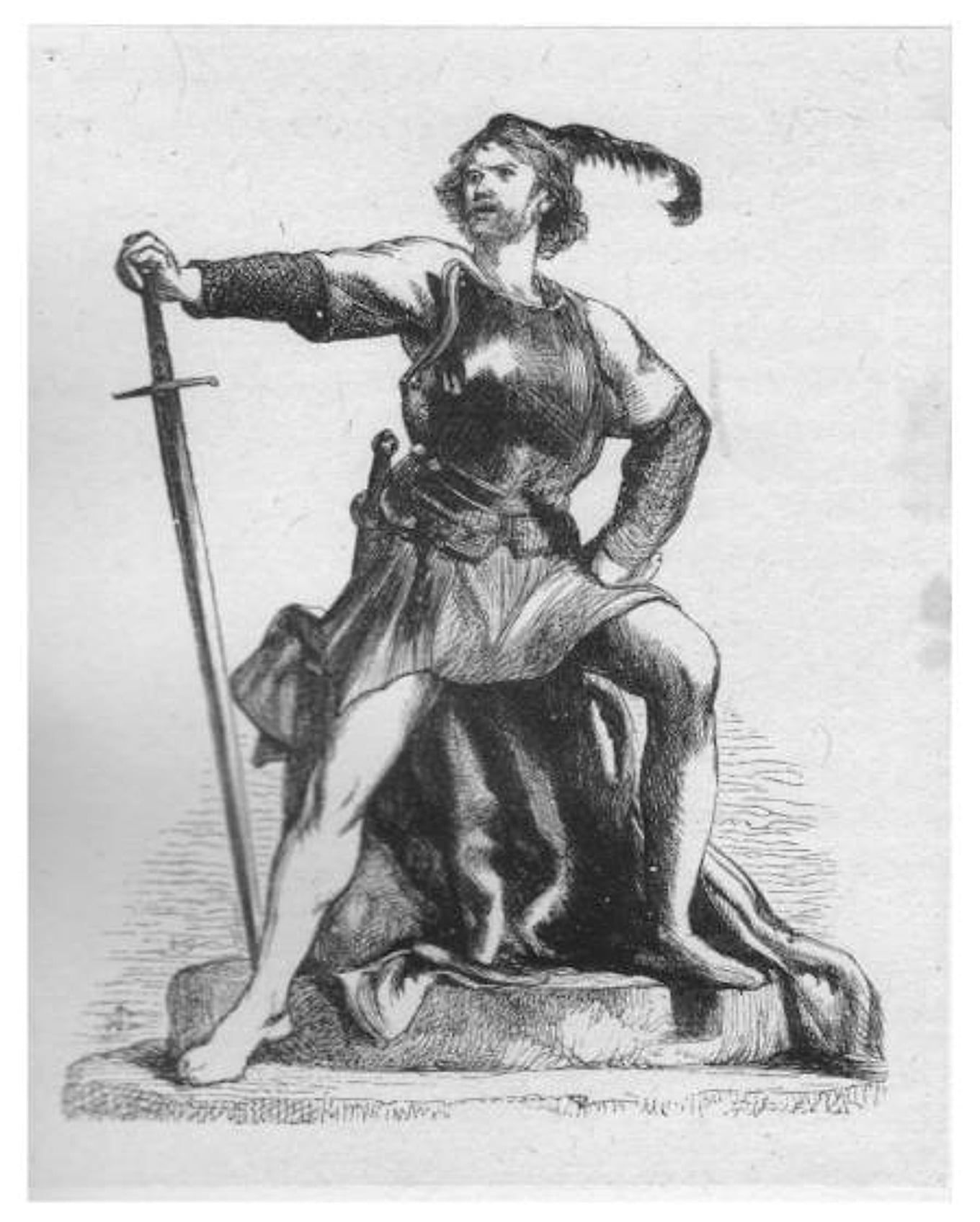
On the afternoon of Friday 3 July 1450, a rebel army from Kent poured across London Bridge into the City of London. At its head, in a blue velvet gown trimmed with sable, wearing gilded spurs and carrying a naked sword, rode their leader, Jack Cade. He rode up Candlewick Street to a large stone set upright in the roadway. According to a London chronicle, “he strake it with his sworde, and sayd, ‘Nowe is Mortymer lorde of this cytie.’”
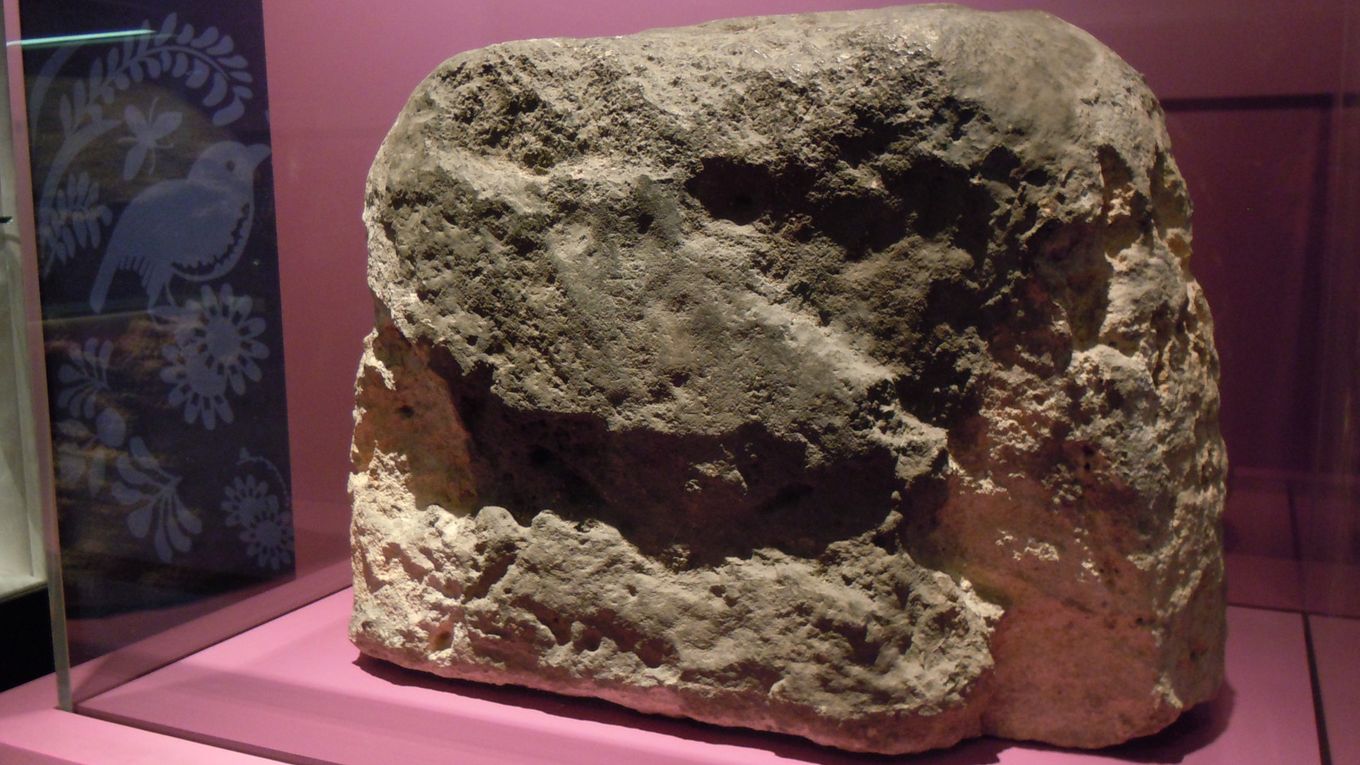
That stone is still there. It is called London Stone, and it is one of the oldest and most mysterious objects in London. Nobody knows who put it there, when, or why. Over the centuries it has been called a Roman milestone, a Druid altar, a Trojan relic and the magic talisman on which the safety of London depends. Almost all of it is invented.
A lump of limestone
What survives today is a battered block of oolitic limestone about 53 cm wide, 43 cm high and 30 cm deep. It sits behind glass in the front of an office building at 111 Cannon Street, opposite Cannon Street station.
It used to be much bigger. In 1598 the historian John Stow described “a great stone called London stone,” set upright on the south side of the street, “fixed in the ground very deep, fastened with bars of iron, and otherwise so strongly set, that if carts do run against it through negligence, the wheels be broken, and the stone itself unshaken.” A French visitor in 1578 recorded that it stood about three feet high.
Geologists who examined a sample in the 1960s thought it was Clipsham stone from Rutland, a high-quality limestone shipped to London by both the Romans and medieval builders. A more recent examination suggests it may instead be Bath stone, which the Romans used for monuments in early London.
“At London Stone”
The stone first appears in the written record around 1100, in a list of London properties owned by Canterbury Cathedral, dated to between 1098 and 1108. One property had been given by a man called “Eadwaker æt lundene stane”: Eadwaker at London Stone. Even then, it was a landmark well known enough to serve as an address.
In 1135, Stow records, a great fire began “in the house of one Ailward, near unto London stone,” and burned the city from Aldgate in the east to St Paul’s in the west. And in 1189, when London chose its first mayor, it picked Henry son of Ailwin, whose family took their name from the stone. A London chronicle records that “Henry, son of Eylwin of London Stone, was made mayor of London.”
Lord of this city
Cade’s rebellion was born of fury at the corrupt government of King Henry VI, which was losing the long war in France, had taxed the country heavily for it, and was lining its own pockets. In June 1450 thousands of men from Kent gathered at Blackheath, just outside London. They were not peasants but farmers, villagers, townsmen and even minor gentry, many of them trained militiamen. Their leader, Jack Cade, called himself John Mortimer, a name that implied he was related to the king’s rival, Richard, Duke of York.
When Cade crossed into the City, he cut the ropes of the drawbridge on London Bridge with his sword so that it could not be raised against him. At first he tried to keep order, issuing proclamations that anyone caught looting would be put to death. Then he rode to London Stone, struck it with his sword and declared himself lord of the city.
The next day things turned ugly. The rebels seized the king’s treasurer, Lord Saye, one of the most hated men in England, and beheaded him at the Standard in Cheapside. According to the chronicle of John Benet, a vicar who was writing within a few years, Cade then stuck Saye’s head and those of two other victims on spears and tied the treasurer’s naked body to his horse. He dragged it out through Newgate, back in through Ludgate, down Watling Street and along Candlewick Street to London Stone. There, Benet says, “he went around a great stone striking it with his sword.” The heads were set up over the gate on London Bridge.
Looting followed, and the Londoners turned on the rebels. On the night of 5 July they fought a savage battle with them on London Bridge, among houses set on fire. By morning the City had held the bridge. The rebels were offered pardons and went home. Cade did not escape. Within days he was declared a traitor, hunted down in Sussex and mortally wounded. His body was brought back to London, beheaded and quartered, and his head was set up on London Bridge.
What did it mean?
Nearly every modern account of London Stone uses Cade’s sword stroke as proof that the stone had a special meaning: that it was where oaths were sworn and proclamations made, and that whoever struck it claimed the city. In 2007 John Clark, a former curator at the Museum of London, went looking for evidence of any of this. He could find none. There is no record of any tradition of striking the stone, swearing on it or proclaiming from it. Even in 1450 not every chronicler thought the incident worth mentioning.
The idea owes much to Shakespeare. In Henry VI, Part 2, Cade does not just strike London Stone. He sits on it as if on a throne, decrees that “the pissing Conduit run nothing but claret wine,” and has a soldier killed for calling him Jack Cade instead of Lord Mortimer. As Clark puts it, “This is great theatre. It is also fiction.” Cade’s sword stroke may simply have been a showman’s improvisation, made up on the spot.

A tourist sight and a noticeboard
By the time of Elizabeth I, London Stone was a sight to be shown to visitors. Tour guides told them it had been there since before London existed, or that the legendary King Lud had set it up, or that it marked the centre of the city. In 1608 the poet Samuel Rowlands listed it among the “sights” shown to “an honest Country foole” up in town.
It was also useful. Printers used it as an address: books were “sold at his shop at St Pauls Head, neere London stone.” And in 1671 the Worshipful Company of Spectacle Makers used it for a public punishment. Having seized 264 pairs of spectacles “all very badd both in the glasse and frames,” they took them to “the remayning parte of London Stone” and smashed them to pieces with a hammer.
The incredible shrinking stone
That phrase, “the remayning parte,” suggests that the stone had been damaged, perhaps in the Great Fire of 1666, which destroyed the neighbouring church of St Swithin. A few decades later it was described as “much worn away, and as it were but a Stump remaining.”
By 1742 it was simply in the way of the traffic. The parish had it moved across the street and set against the wall of St Swithin’s church, at a cost of twelve shillings. In 1798 it was “doomed to destruction as a nuisance,” and was saved only by the intervention of a local printer, Thomas Maiden. It was cut down to roughly its present size and set into the church wall. In 1869 the London and Middlesex Archaeological Society gave it an iron grille and a plaque. Nobody paid much attention. In 1888 a magazine reported that a fruit stall usually hid it from view, with twine wound round the grille and “piles of paper bags” resting on the stone itself.
St Swithin’s church was gutted by bombing in the Blitz, but London Stone survived in its shattered wall. When the ruins were demolished in 1962, the stone was built into the new office block on the site, built to house the Bank of China. It spent the next half-century in a glass-fronted alcove at pavement level. Its last setting was perhaps its least dignified. Until 2016 the ground floor was a branch of WHSmith, and inside the shop London Stone’s glass case was hidden behind a magazine rack.
In 2016, when the building was knocked down and rebuilt, the stone spent two years on display at the Museum of London. In October 2018 it went back to Cannon Street, where it now stands on a plinth behind glass in a new Portland stone frame, with a plaque explaining that its original purpose is unknown.
Questions and answers
Is London doomed if the stone is ever destroyed?
That is the most famous claim about London Stone: an “ancient saying” that “So long as the Stone of Brutus is safe, so long shall London flourish.” Brutus was the legendary Trojan prince who was supposed to have founded London as “New Troy.” But the saying cannot be traced any earlier than 1862, when it appeared in the magazine Notes and Queries under the pen name “Mor Merrion.” The author was an eccentric Welsh clergyman, Richard Williams Morgan, who believed Brutus was a real person and that London Stone had once been the base of a sacred statue from Troy. He almost certainly made the saying up
Was it a Roman milestone?
Possibly not. In 1586 the antiquarian William Camden suggested that it was a Roman milliarium, the central stone from which distances across Roman Britain were measured, like the Golden Milestone in the Forum in Rome. The idea is still repeated, but there is no evidence for it. Christopher Wren, who saw its foundations after the Great Fire, thought it had been part of a much larger monument. Today the most popular theory among archaeologists is that it came from the main gate of a huge Roman building that once stood under what is now Cannon Street station, possibly the palace of the Roman governor. That cannot be proved either.
Did John Dee experiment on it, or did King Arthur pull a sword from it?
There is no evidence for either. Claims that the Elizabethan magician John Dee chipped bits off London Stone for his alchemy, and that it was the stone from which King Arthur drew the sword, seem to have first appeared around 2002. The Dee story may have been inspired by Peter Ackroyd’s 1993 novel The House of Doctor Dee, in which a fictional Dee is obsessed with the stone.
Key dates
- 1098–1108
- The first record of London Stone, in a list of Canterbury Cathedral's London properties
- 1135
- A great fire starts 'near unto London stone' and burns from Aldgate to St Paul's
- 1189
- Henry, son of Ailwin of London Stone, becomes London's first mayor
- 3 July 1450
- Jack Cade strikes London Stone with his sword and claims to be lord of the city
- 1742
- The stone is moved to the north side of the street as an obstruction to traffic
- 1798
- Saved from destruction and set into the wall of St Swithin's church
- 1962
- Built into a new office building after the bombed church is demolished
- 2016–2018
- Displayed at the Museum of London while the building is rebuilt, then returned to Cannon Street
Further reading
The Jack Cade Rebellion: The Revolt That Led to the Wars of the Roses
Jake Newitt · A new account of the revolt that brought Cade to London Stone with his sword in hand, tracing its role in lighting the fuse for the Wars of the Roses.
View on Bookshop.org: The Jack Cade Rebellion: The Revolt That Led to the Wars of the Roses
London: The Biography
Peter Ackroyd · A sweeping history of London across two thousand years, ranging through the myths, legends and tall tales that gathered around landmarks like London Stone.
View on Bookshop.org: London: The BiographyThis article contains affiliate links. If you buy through them, Yorewire may earn a small commission at no extra cost to you. Affiliate disclosure.
Sources
- 1John Clark, 'Jack Cade at London Stone', Transactions of the London and Middlesex Archaeological Society 58 (2007), pp. 169–189, via the Archaeology Data Service (The fullest modern history of the stone, by a former curator at the Museum of London, quoting the medieval chronicles of Cade's rebellion.)
- 2John Stow, A Survey of London (1598; 1603 edition), via Project Gutenberg (The first attempt at a history of the stone, by the great Elizabethan historian of London.)
- 3John Clark, 'London Stone: Stone of Brutus or fetish stone – making the myth', Folklore 121 (2010), pp. 38–60 (Traces where each of the myths about the stone came from.)
- 4'London Stone to go on show at the Museum of London', Londonist, May 2016 (The stone's move to the Museum of London while 111 Cannon Street was rebuilt.)
- 5'London Stone', Wikipedia (Used for background. In 2008 Wikipedia claimed the stone was where oaths were sworn and proclamations made; Clark found no evidence for any of it, and the article has since been corrected.)