The British Cruiser That Torpedoed Itself in the Arctic
Escorting a convoy to Russia through the Barents Sea, the cruiser HMS Trinidad caught a German destroyer in a snowstorm and moved in for the kill. Her torpedo ran amok, turned in a circle and came back at her. Most of the men it killed were trapped deep in the ship as fuel oil poured in, among them nearly the whole ship's band.
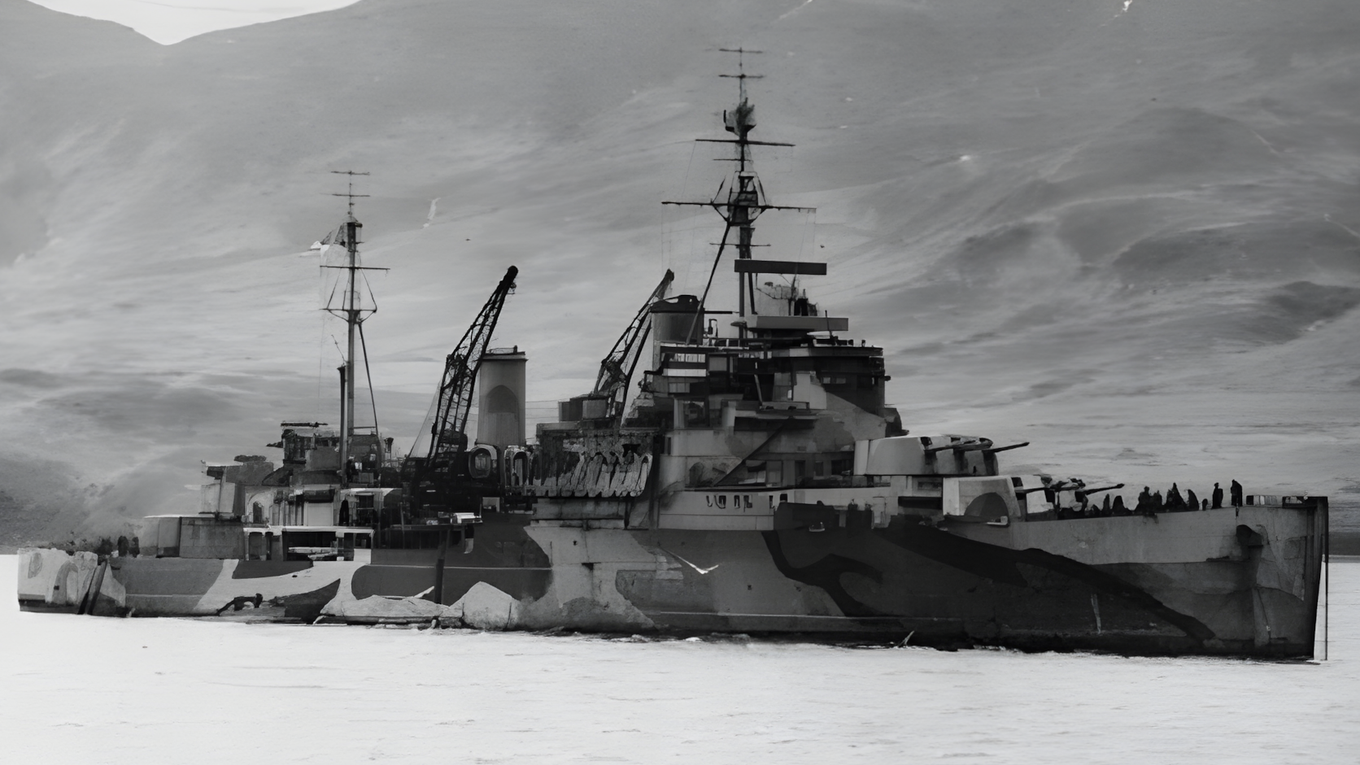

On the morning of 29 March 1942, in the Barents Sea north of Russia, the cruiser HMS Trinidad was hunting a German destroyer through a snowstorm.
She had already hit it hard. An hour earlier, Trinidad’s radar had picked up three German destroyers closing on the scattered merchant ships of Convoy PQ 13, bound for Murmansk with tanks, aircraft and ammunition for the Soviet Union. Trinidad opened fire at point-blank range, and her second salvo smashed into the leading destroyer, Z26, knocking out two of her guns and setting her on fire. Now Z26 was alone, damaged and twisting through the snow squalls, and Trinidad was closing in to finish her off.
At about 9.22 am Trinidad fired a torpedo. It was the only one to leave the tubes. Two others had frozen in place.
Minutes later, lookouts saw a torpedo track coming towards the cruiser. It was their own.
Convoys to Russia
Trinidad was brand new. She had been completed only five months earlier, an 8,500-ton cruiser armed with twelve six-inch guns and six torpedo tubes. Since Germany had invaded the Soviet Union in June 1941, Britain had promised to keep the Russians supplied, and the only route open was the most dangerous of the war: round the North Cape of Norway, along the edge of the Arctic ice, to Murmansk and Archangel.
The convoys had to pass within range of German bombers, U-boats and warships based in occupied Norway. The weather was another enemy. In winter there was barely any daylight. Gales could blow for days. Spray froze on the ships as it landed, and crews had to chip away tons of ice to stop them becoming top-heavy and capsizing.
PQ 13 sailed from Iceland on 20 March 1942 with 19 merchant ships. Within days a gale had scattered them across 150 miles of sea. The German air force found them, and German destroyers came out from Kirkenes to pick off the stragglers. Trinidad and the destroyer Fury were sent to stop them.
The torpedo that came back
A torpedo of 1942 was a small, self-driving submarine. Once fired, it was kept on course by a gyroscope, which worked the rudders to hold the heading set before launch. If the gyroscope failed, the torpedo could wander, or run in a circle.
That is what happened. The torpedo curved round and came back towards the ship that had fired it. The bridge ordered the wheel hard over, but there was no time. It struck Trinidad on the port side, below the bridge.
No one has ever proved exactly what went wrong. The usual explanation is the cold. In the freezing conditions, the oil lubricating the gyroscope and steering gear is thought to have thickened, so that the gyroscope could not hold the torpedo straight. The fact that two other torpedoes had frozen solid in their tubes suggests the weapons were in a poor state.
The transmitting station
The torpedo hit the worst possible place. It blew a hole in the ship next to the Royal Marines’ mess deck and a large fuel tank, and the forward boiler room flooded with fuel oil, which caught fire.
Deep below, beneath the waterline, was the transmitting station, the room that calculated the range and bearing for the main guns. It was manned by men of the ship’s Royal Marine band. In the Navy, bandsmen did not play in action; they worked the fire-control tables. One of them was George Lloyd, a 28-year-old composer who had written Trinidad’s official march.
The explosion ruptured the fuel tanks around them, and thick black oil came pouring into the compartment through the hatch. The only way out was up a single ladder. “The oil was now up to our groins,” Lloyd remembered. Some of the men seemed paralysed. There were 21 men in the transmitting station, he wrote, and seventeen died. Lloyd was the last man to get out.
Thirty-two men were killed by the torpedo. They included nine men of the ship’s band, among them the bandmaster, a midshipman, a teenage Boy Seaman, a New Zealander, stokers, telegraphists and an electrical lieutenant.
Friendly fire in the snow
Trinidad lurched to a stop with a heavy list to port. The fight went on around her in the snow. Fury went after Z26, met another British destroyer, Eclipse, coming out of a squall, and fired two salvoes at her before realising she was friendly. Eclipse in turn took up the chase and pounded Z26 until the German destroyer was dead in the water and sinking. Then the snow cleared, revealing the other two German destroyers, which drove Eclipse off and rescued the survivors. Z26 sank. Of her crew, 243 were killed. Like two Spanish warships that destroyed each other in the dark in 1801, the ships at sea that morning could barely tell friend from foe; the next year American and Canadian troops would shoot each other in the Aleutian fog on an island the enemy had already left.
Trinidad’s engineers got her moving again. With a U-boat stalking her, she limped into the Kola Inlet on 30 March. When she was docked in Murmansk a week later, the bodies of her dead were recovered from the flooded compartments. They were buried at sea.
The Navy kept the cause quiet. When the Home Fleet’s commander, Admiral Sir John Tovey, wrote his official report on the Russian convoys, published in 1950, he said only that Trinidad had been “hit by a torpedo.” He did not say whose.
The second sinking
Trinidad spent six weeks in Murmansk, patched up with steel plates brought out by another cruiser, HMS Edinburgh. On 13 May she sailed for home, heading for permanent repairs in the United States. She could make only about 20 knots. Among those on board were survivors of Edinburgh, which had been torpedoed and sunk two weeks earlier, and merchant seamen whose ships had been lost on the convoys.
The next day she was found by German aircraft. That evening, south-west of Bear Island, more than twenty Junkers Ju 88 bombers attacked. One bomb hit her near the old torpedo damage and set the forward part of the ship ablaze. The fire could not be put out. After three hours she was abandoned, and in the early hours of 15 May the destroyer Matchless sank her with torpedoes. More than 60 men were lost, among them men who had already survived the sinking of their own ships.
Questions and answers
What happened to George Lloyd?
He never fully recovered from the shell shock. He was invalided out of the Marines, and his Swiss wife Nancy nursed him back to health in Switzerland. He later bought a market garden in Dorset, growing mushrooms and carnations, and composed in the early mornings before work. For years the BBC sent his tuneful symphonies back unplayed. In the 1970s he moved to London and enjoyed a late revival, recording many of his twelve symphonies, including his fourth, the “Arctic.” In 2013, long after his death, his HMS Trinidad March was played at the Last Night of the Proms, with the last surviving member of Trinidad’s crew in the audience.
Has any other ship been sunk by its own torpedo?
Yes, and with worse losses. In October 1944 the American submarine Tang, one of the most successful US submarines of the war, fired the last of her torpedoes at a Japanese convoy in the Formosa Strait. It turned in a circle and hit her stern, and she sank in seconds. Of her 87 men, nine survived to become prisoners of the Japanese, including her captain, Richard O’Kane, who was awarded the Medal of Honor. Circular runs were a known danger of torpedoes, which is why submarines and warships were trained to dodge their own.
What was HMS Edinburgh carrying when she sank?
Gold. When Edinburgh left Murmansk at the end of April 1942, her bomb room held 465 gold bars, about five and a half tonnes, sent by the Soviet Union to pay for American and British war supplies. After she was torpedoed by a U-boat and then by German destroyers, she was scuttled with the gold still aboard. It stayed on the seabed for almost forty years. In 1981 a salvage team led by the Yorkshire diver Keith Jessop cut into the wreck and brought up 431 of the bars, the largest recovery of sunken treasure at the time. The rest are still down there.
Key dates
- 14 October 1941
- HMS Trinidad is completed and joins the Home Fleet
- 20 March 1942
- Convoy PQ 13 sails from Iceland for Murmansk
- 29 March 1942
- Trinidad fights three German destroyers and is hit by her own torpedo
- 30 March 1942
- Trinidad reaches Murmansk
- 13 May 1942
- Trinidad sails for home after temporary repairs
- 14 May 1942
- Set on fire by German bombers south-west of Bear Island
- 15 May 1942
- Abandoned and sunk by a British destroyer's torpedoes
Further reading
Arctic Convoys 1941-1945
Richard Woodman · A full history of the Arctic convoys to Russia, the most dangerous convoy route of the war, including the action in which Trinidad torpedoed herself.
View on Bookshop.org: Arctic Convoys 1941-1945This article contains affiliate links. If you buy through them, Yorewire may earn a small commission at no extra cost to you. Affiliate disclosure.
Sources
- 1Admiral Sir John Tovey, 'Convoys to North Russia, 1942', despatch published in the Supplement to the London Gazette, 13 October 1950 (The Home Fleet commander's official report. It says only that Trinidad was 'hit by a torpedo', without saying whose. For her final loss it gives one officer, 60 naval ratings and 20 merchant seamen taking passage; Wikipedia says 63 men, including 20 survivors of the cruiser Edinburgh.)
- 2Naval-History.net, 'HMS Trinidad' service history and Royal Navy casualty list for 29 March 1942 (Records that the torpedo hit 'on port side forward of Bridge structure' and that the forward boiler room 'flooded with oil fuel which ignited'. The casualty list names the 32 dead, including nine members of the Royal Marine band.)
- 3Tom Lambert, 'HMS Trinidad', Blue Band magazine, via the Royal Marines Bandsmen website (Quotes George Lloyd's own statement about the transmitting station: 'There were twenty one men in the transmitting station. Seventeen died.')
- 4'HMS Trinidad (46)' and 'German destroyer Z26', Wikipedia (Used for the course of the action.)