Dwarf, Duellist, Soldier, Slave: The Life of Jeffrey Hudson
At seven, Jeffrey Hudson was baked into a pie and served to the Queen of England. By twenty-five he had fought in a civil war and shot a man dead in a duel on horseback. Then pirates sold him into slavery in North Africa, where, he swore, the beatings made him grow.

In 1626, at a banquet for King Charles I and his teenage French queen, Henrietta Maria, the servants carried a great cold pie to the table and set it down in front of the Queen. When the crust was broken, out stepped a boy. He was about seven years old and perfectly formed, and he was eighteen inches tall. His name was Jeffrey Hudson, and the Queen was so delighted with him that he was given to her on the spot.
It was the start of one of the strangest lives of the seventeenth century. The boy from the pie would become a royal favourite, a captain of horse in a civil war and a killer in a duel. He spent years as a slave in North Africa, was later imprisoned for being Catholic, and ended his days in poverty.
The least man of the least county
Jeffrey Hudson was baptised at Oakham, in Rutland, on the 14th of June 1619. His father, John, kept and baited bulls for George Villiers, Duke of Buckingham, the King’s great favourite. John Hudson was a big man, and so were all his other children. Only Jeffrey was different.
By the time he was seven, he was still only about eighteen inches tall, about the height of a large toddler. But unlike many people of very short stature, he was perfectly proportioned. He was, Historian Thomas Fuller wrote, “without any deformity, wholly proportionable.” Modern doctors think he probably had a disorder of the pituitary gland that caused a lack of growth hormone.
His father presented him to the Duchess of Buckingham at Burley-on-the-Hill, the Duke’s great house near Oakham. She took him into her household as “a Rarity of Nature,” and overnight, Jeffrey was raised “not in stature but in condition, from one degree above rags into silk and satin, and two tall men to attend him.” Fuller summed him up as “the least man of the least county in England.”
The boy in the pie
Not long afterwards, the King and Queen visited Burley-on-the-Hill while on a royal progress. The Duke laid on a feast, and as its climax, the little boy “was served up to the Table in a cold Pye.” When the Queen saw him rise out of the pastry, she was enchanted, and Jeffrey Hudson left Rutland as her personal dwarf.
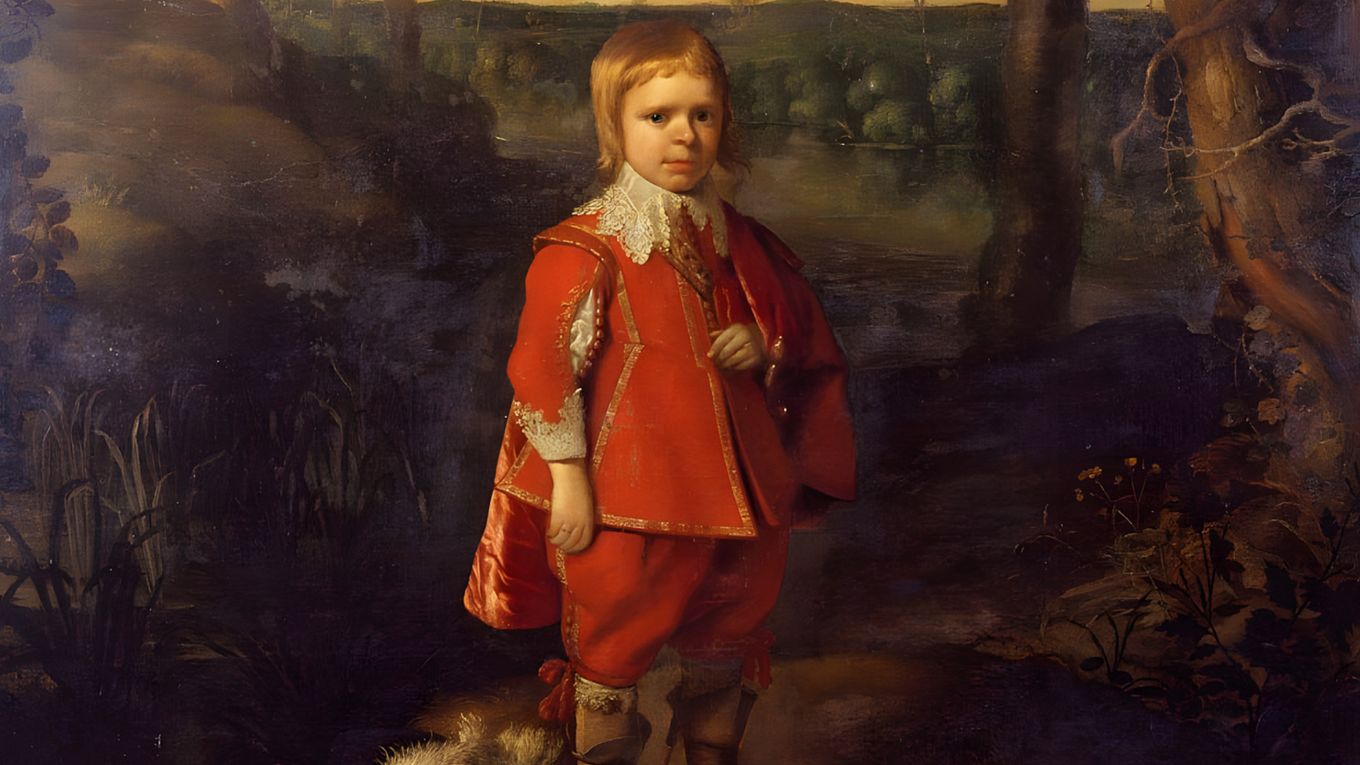
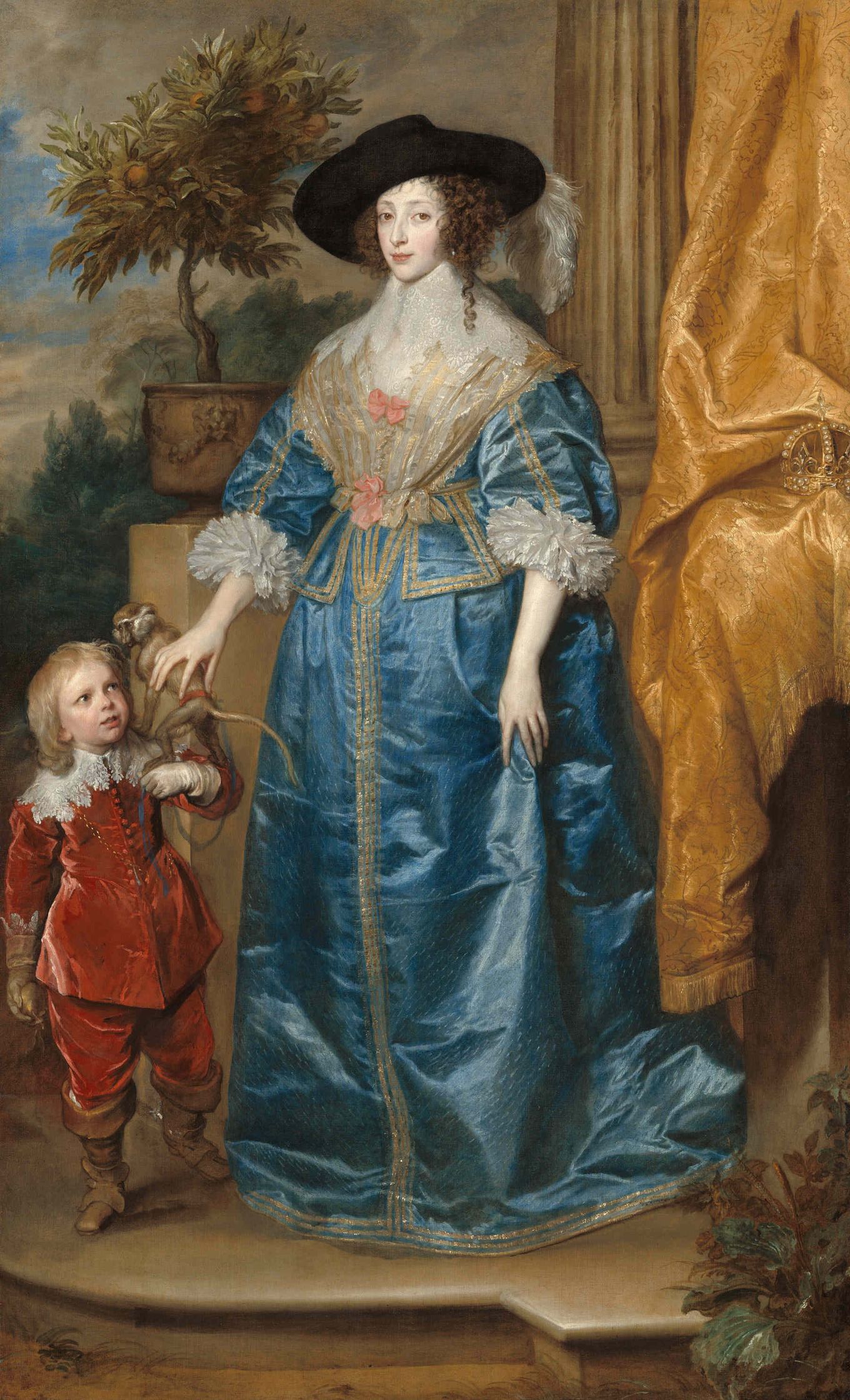
He joined a royal household that collected curiosities. Among the Queen’s attendants were other dwarfs, a giant Welsh porter named William Evans and a monkey called Pug. Hudson became the star. He was dressed by the court tailors in miniature suits, given his own little suit of armour and a velvet saddle with silver fringes. The painter Daniel Mytens was paid £40 for “a picture at large of Jeffry the dwarf in a wood or wilderness,” and Hudson appears beside the Queen in Anthony van Dyck’s famous portrait of 1633.

He was quick-witted, and he knew how to play to a crowd. In 1631 a papal envoy was handing out rosaries to the Queen’s Catholic ladies when the boy, then about twelve, called out, “Madam, show the father that I also am a Catholic!” Everyone laughed. But his success went to his head. Fuller says he grew so proud that “he did not know himself, and would not know his father,” and that he was punished for it on the King’s own orders.
First capture by pirates
Hudson’s adventures began early. In 1630, at about ten years old, he was sent to France with a party fetching a midwife for the pregnant Queen. On the way home their ship was captured by pirates from Dunkirk, and Hudson, the midwife and the Queen’s dancing master were carried off as prisoners. They were released, but the episode was so famous that the poet William Davenant wrote a mock-heroic poem about it, Jeffereidos.
A captain in the Civil War
When civil war broke out between Charles I and Parliament in 1642, Hudson stayed loyal. He went with the Queen to the Netherlands to raise money for the King’s army, came back with her to the royalist headquarters at Oxford, and was made a captain of horse. Nobody knows whether he ever led men in battle, but he took the rank seriously and called himself “Captain Jeffery Hudson” for the rest of his life.
In 1644, with the war going badly, the Queen fled to France, and Hudson went with her.
The duel at Nevers
In exile at Nevers, in central France, Hudson was in no mood to be laughed at. He had been a soldier; he was in his mid-twenties; he was done being the court’s pet. When a young courtier named Crofts, the brother of the Queen’s Master of the Horse, mocked him, Hudson challenged him to a duel.
Crofts did not take it seriously. According to one account, he turned up armed with nothing but a large water squirt, the kind used to put out fires. He had made a fatal mistake. The two men fought on horseback, and a London newspaper reported in October 1644 that Hudson, “running his horse in full career, shot his antagonist in the head, and left him dead on the spot.” As Fuller put it, “a pistol is a pure leveller, and puts both dwarf and giant into equal capacity to kill and be killed.”
The Queen was horrified. Duelling was illegal in France, and the dead man’s brother was one of her most important officers. On the 20th of October 1644 she wrote to Cardinal Mazarin, who effectively ran France, about “a misfortune which has happened to my house, of Geoffrey, who has killed Croft’s brother,” and asked to be allowed to deal with the matter herself, “in dispensing either justice or favour.” She chose favour. Hudson was spared, but he was expelled from her court.
Slave of the Barbary corsairs
At sea once more, Hudson was captured again, but this time the outcome was far worse. James Wright, who heard the story from Hudson himself, wrote that “a Turkish Pirate” took him “and carried him to Barbary, where he was sold, and remain’d a slave for many years.”
The corsairs of Algiers, Tunis and Salé captured thousands of European sailors and travellers in this period and sold them in the slave markets of North Africa. Men were put to work in galleys, quarries or households, and many never came home. No record survives of where Hudson was held or what work he did. All we have is his own summary: “hardship, much labour, and beating.”
Nobody knows exactly how long he was a slave. The Victorian Dictionary of National Biography thought he might have been home by 1658, but modern historians find no firm record of him in England until 1669, which would mean as long as twenty-five years in captivity. In the 1660s, English missions were sent to Algiers and Tunis to ransom captives, and he was probably freed by one of them.
The man who grew in captivity
When Jeffrey Hudson came home, he was no longer eighteen inches tall. He told Wright, “several times,” that between the age of seven and the age of thirty he had hardly grown at all, “but after thirty he shot up in a little time” to about three feet nine inches. He blamed his slavery. Wright was puzzled: “This seems a Paradox, how that which hath been observed to stop the growth of other persons, should be the cause of his. But let the Naturalists reconcile it.”
Whatever the cause, the tiny wonder of the court had become a short, weathered, middle-aged man, nobody would be baking him into a pie any more.
Prison and a pauper’s death
Hudson returned to Rutland and lived for some years on small pensions from the second Duke of Buckingham and other noblemen. The court that had made him famous had gone. The Queen who had saved his life left England in 1665 and died in France in 1669.
Around 1676 he went to London, perhaps hoping for a royal pension, and arrived at the worst possible time. In 1678 a fellow native of Oakham, Titus Oates, invented the “Popish Plot,” claiming that Catholics were plotting to murder the King. In the panic that followed, Hudson, “being known to be a Roman Catholick,” was arrested and locked up in the Gatehouse prison at Westminster, where, Wright says, “he lay a considerable time.” He was released in 1680, and in 1680 and 1681 Charles II paid “Captain” Jeffery Hudson £50 and then £20 from his secret service fund.
He died around 1682, in obscurity, and was buried in an unmarked grave.
Questions and answers
What became of Queen Henrietta Maria?
Her life fell apart soon after Hudson’s did. Her husband, Charles I, was beheaded by Parliament in 1649, leaving her almost penniless in exile in France. When her son was restored to the throne as Charles II in 1660, she came back to England, but the diarist Samuel Pepys was unimpressed, describing her as “a very little plain old woman.” Plagued by bronchitis, which she blamed on the damp English weather, she returned to France in 1665. She died at the Château de Colombes, near Paris, in September 1669, after taking too large a dose of opiates prescribed as a painkiller. She was buried among the kings of France at Saint-Denis.
How did he escape slavery?
Nobody knows the details. Very few European slaves escaped from North Africa; most of those who came home were ransomed. In England, money for ransoms was raised through a special tax on merchants’ goods, the “Algiers Duty,” and through collections in parish churches, and government agents were sent to Algiers to buy captives back. In the 1660s, after the Restoration, several English missions went to Algiers and Tunis to free captives, and Hudson was most likely released by one of them. He was then around fifty.
What was life like for an English slave in Barbary?
Brutal, if the men who survived it are to be believed. In February 1661 Samuel Pepys spent an afternoon in a tavern with two English captains who had been slaves in Algiers. They told him slaves ate “nothing but bread and water,” were “beat upon the soles of their feet and bellies” whenever their master pleased, and were locked up every night in their master’s prison. When they were finally ransomed, they even had to pay for the water they had drunk from the public fountains while they were slaves. Hudson never described his own captivity in detail, but he told of “hardship, much labour, and beating.”
Does anything that belonged to him survive?
Some of his clothes do, or did. A pair of his boots and a masquing suit were on show in John Tradescant’s famous cabinet of curiosities in London in the 1650s, and by the nineteenth century a waistcoat, breeches and stockings said to be his were in the Ashmolean Museum in Oxford, which grew out of Tradescant’s collection. He can also still be seen in paint: Daniel Mytens’s portrait of him standing in a wood is in the Royal Collection, and Anthony van Dyck’s portrait of Henrietta Maria with Hudson at her side hangs in the National Gallery of Art in Washington.
Key dates
- 14 June 1619
- Jeffrey Hudson is baptised at Oakham in Rutland, the son of a man who kept bulls for the Duke of Buckingham
- 1626
- Taken into the Duke of Buckingham's household, he is served to Charles I and Henrietta Maria in a cold pie and given to the Queen
- 1630
- Returning from a mission to France, he is captured by pirates and held at Dunkirk
- 1642–1644
- During the Civil War he serves the royalist cause as a captain of horse, then follows the Queen into exile in France
- October 1644
- At Nevers he kills a courtier named Crofts in a duel on horseback and is expelled from the Queen's court
- c. 1645
- Captured at sea by Barbary pirates, he is sold into slavery in North Africa
- By 1669
- Ransomed and back in England, he claims to have grown from 18 inches to 3 feet 9
- 1679–1680
- Imprisoned in the Gatehouse at Westminster as a Catholic during the Popish Plot
- c. 1682
- Hudson dies in poverty and obscurity
Further reading

Henrietta Maria: Conspirator, Warrior, and Phoenix Queen
Leanda de Lisle · A biography of Queen Henrietta Maria, whose household and court Hudson served for most of his life.
View on Bookshop.org: Henrietta Maria: Conspirator, Warrior, and Phoenix Queen
The Smallest Man
Frances Quinn · A historical novel narrated by Jeffrey Hudson, imagining his life at court and beyond from his own point of view.
View on Bookshop.org: The Smallest Man
White Gold: The Extraordinary Story of Thomas Pellow and North Africa's One Million European Slaves
Giles Milton · A popular history of the Barbary corsairs and the European captives, including Englishmen, sold into slavery in North Africa, the fate Hudson himself suffered.
View on Bookshop.org: White Gold: The Extraordinary Story of Thomas Pellow and North Africa's One Million European SlavesThis article contains affiliate links. If you buy through them, Yorewire may earn a small commission at no extra cost to you. Affiliate disclosure.
Sources
- 1Thomas Fuller, The History of the Worthies of England (1662), ed. P. Austin Nuttall, vol. 3 (London, 1840), 'Rutland', pp. 40–41 (Written during Hudson's lifetime, partly from witnesses who had seen him presented to the Duchess of Buckingham.)
- 2James Wright, The History and Antiquities of the County of Rutland (London, 1684), p. 105 (Written two years after Hudson's death by a local antiquarian who had heard Hudson tell his own story 'several times'.)
- 3Mary Anne Everett Green (ed.), Letters of Queen Henrietta Maria (London, 1857), pp. 30–31, 259–260 (Includes the Queen's letter of 20 October 1644 about the duel, a London newspaper report of the fight, and a papal envoy's anecdote about Hudson in 1631.)
- 4W. A. J. Archbold, 'Hudson, Jeffery', Dictionary of National Biography, vol. 28 (1891) (Victorian biography; useful for Hudson's later years and the royal payments to him, but its date for the duel is wrong.)
- 5'Jeffrey Hudson', Wikipedia (Draws on Nick Page, Lord Minimus (2002), and the Oxford Dictionary of National Biography; used for details of court life and his return to England.)
- 6Samuel Pepys, Diary, 8 February 1660/61 (Pepys's record of a conversation with two Englishmen who had been slaves in Algiers.)
- 7'Barbary Pirates and English Slaves', Historic UK (Background on the ransoming of English captives, including the Algiers Duty and church collections.)
- 8'Henrietta Maria' and 'William Crofts, 1st Baron Crofts', Wikipedia (Used for the later lives of the Queen and of Lord Crofts.)