The Most Successful Pirate That Ever Infested Any Sea
For four decades Rahmah ibn Jabir waged a private war at sea against the rulers of Bahrain. When his enemies finally caught up to him, the blind, partially crippled old pirate took his eight-year-old son below deck and blew up his own ship along with everyone on it.
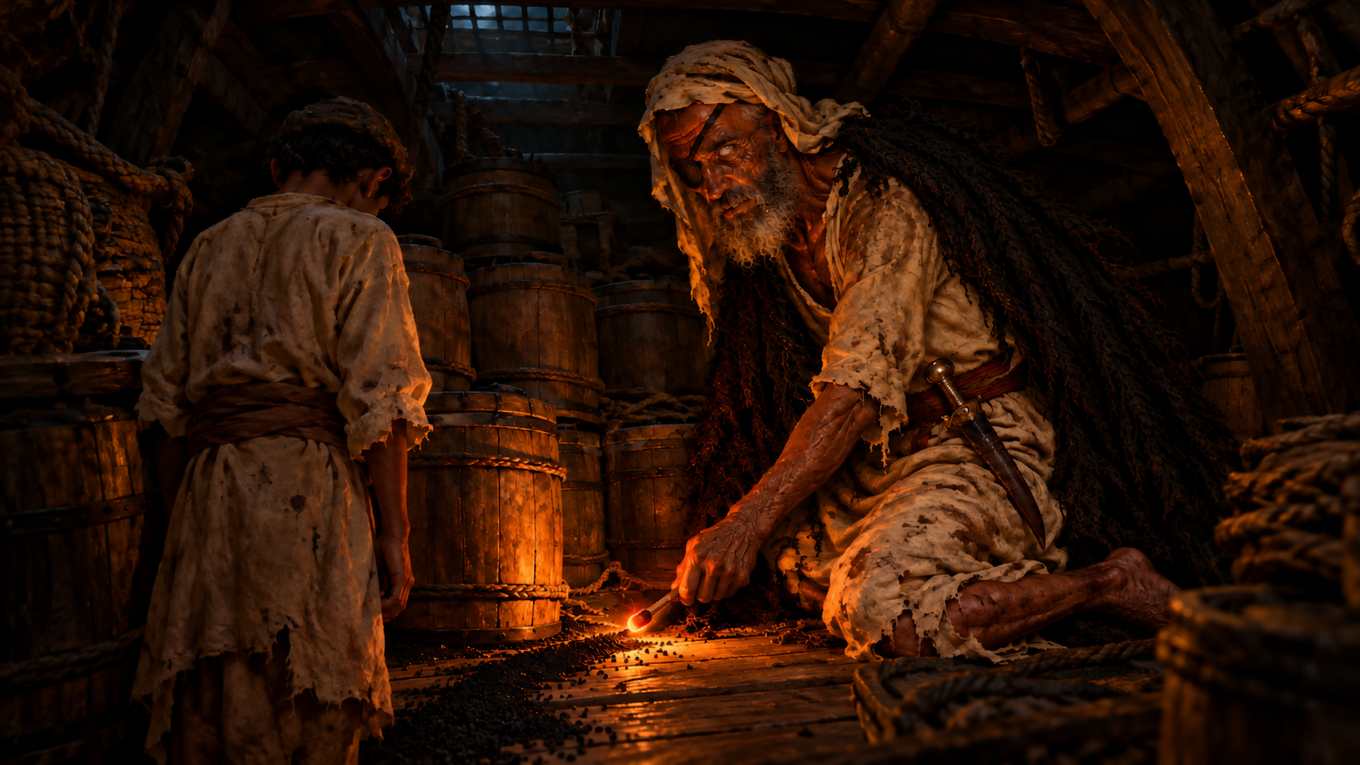
In 1826, off the coast of Dammam on the Arabian shore of the Persian Gulf, two warships lay lashed together while their crews hacked one another to pieces. According to the Arabian chronicler Ibn Bishr, “the scuppers of the two boats flowed with blood.” On one deck stood an old man in filthy shirt, his body covered in scars, one arm without a bone in it, and by now almost completely blind. Knowing the battle was lost, he took his eight-year-old son below deck, made his way to the powder magazine, and lit it with a coal from his hookah pipe.
The old man was Rahmah ibn Jabir ibn Adhbi al-Jalhami, and after terrorising the Gulf for 40 years, had become the most successful pirate in history.
The quarrel over Bahrain
Rahmah was born around 1760 into the Jalahimah, one of the clans of the Utub, an alliance of Arab families who had settled at Kuwait in the eighteenth century and grown rich on trade. In 1783 the Jalahimah joined their cousins, the Al Khalifa, in seizing the island of Bahrain from Persian control. It was a rich prize, the centre of the Gulf’s pearling and trade.
The victory split the allies. The Jalahimah believed they had been cheated of their fair share, and they left. After spells on Kharg Island and at Bushehr on the Persian coast, they settled at Khor Hassan, on the north-west coast of the Qatar peninsula, within sight of the trade routes to Bahrain. There, Rahmah, a younger son of their chief, Jabir, fought his elder brother Abdullah for the leadership and won. Abdullah fled to Muscat and died there.
From then on, Rahmah’s life had a single purpose. He would fight the Al Khalifa of Bahrain wherever he found them, with whoever would help him, until one of them was dead.
The terror of the Gulf
The name of Rahmah ibn Jabir soon became, in the words of J. G. Lorimer’s official British history of the Gulf, “notorious as that of a daring and successful freebooter.” In 1809 a Persian fleet sailed from Bushehr to punish him. Rahmah beat it and captured some of its ships. Later that year he took 20 vessels belonging to his Utub cousins as they sailed from Kuwait to Muscat. The son of the ruler of Kuwait, who was commanding the convoy, was killed.
He changed allies as often as the wind. At various times he fought alongside the Wahhabi rulers of central Arabia, the Sultan of Oman, the Persians and even the Ottoman Egyptian army, and he turned on each of them in turn. The only fixed point was his hatred of Bahrain. When the Wahhabis held the upper hand, between 1809 and 1811, Rahmah captured eighteen loaded ships from Bahrain and its allies and took vessels from Muscat, Bushehr and other ports. With a very few exceptions, Lorimer says, he “put the crews to death.” In short, “he created a reign of terror in the Gulf.”
His fortunes rose and fell. In 1811 his allies were driven out of Qatar and he moved his base to Dammam, on the Arabian coast north of Bahrain. In 1816 he switched sides once too often, and the Wahhabis blew up his fort. He fled to Bushehr with his followers and their families, and was back in Dammam within two years.
A cautious side
What made Rahmah unusual was not his cruelty, which was common enough in the Gulf wars of the time, but his caution. These were the years when the British East India Company was sending warships into the Gulf to crush the raiders of the “Pirate Coast,” the shores of what is now the United Arab Emirates. Rahmah never gave them an excuse. Lorimer, writing from the British records, says that towards British subjects and officials his conduct was “scrupulously correct.” On one occasion he had a British cruiser at his mercy and let it go.
So when the British planned their first expedition against the pirates of Ras al-Khaimah in 1809, they decided to leave Rahmah alone. When the British Resident at Bushehr wanted to destroy his ships anyway, the government in Bombay overruled him. Lorimer himself concluded that in his closing years Rahmah “was rather a petty territorial ruler, with head-quarters at Dammam, than a pirate.” Whether he was a pirate or not depended on whose ship he was attacking.
Dinner with a pirate

The only first hand description we have of Rahmah comes from James Silk Buckingham, an English traveller who saw him at the British Residency in Bushehr in 1816. Buckingham called him “the most successful and the most generally tolerated pirate, perhaps, that ever infested any sea.”
Rahmah’s fleet was then anchored in the harbour: five or six large ships with crews of two or three hundred men each. His followers, perhaps two thousand of them, were mostly his own African slaves, and Buckingham says he ruled them by terror. When some of his crew muttered mutinously, he had them shut inside the ship’s water tank and closed the lid. They all suffocated, and their bodies were thrown overboard.
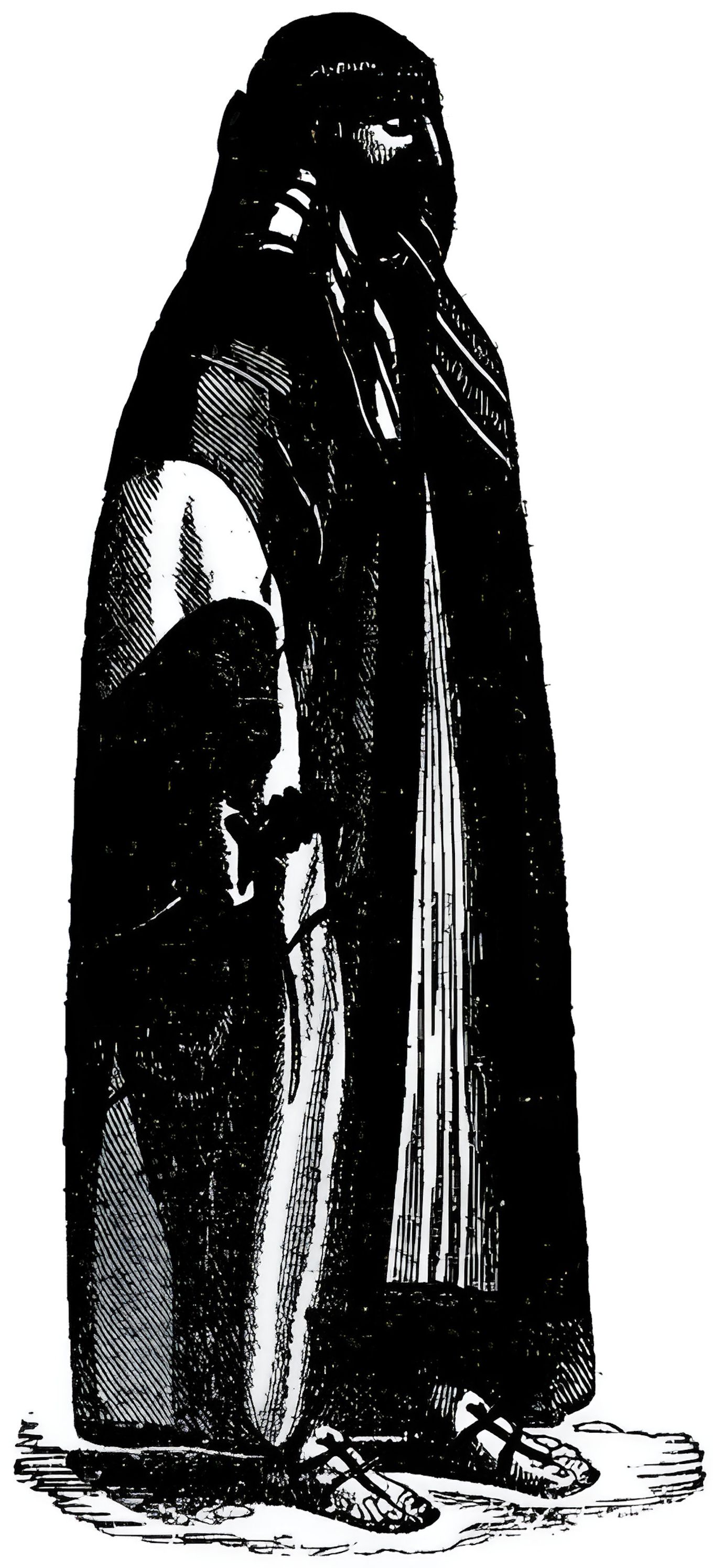
Buckingham was disgusted by his appearance. Rahmah wore a single shirt “never taken off to be washed from the time it is first put on till it is worn out,” with no covering for his legs and a black goat’s-hair cloak over everything. His men sat at the Residency’s breakfast table picking lice off their skin and throwing them on the floor. He went on to describe his body:
Rahmah-ben-Jaber’s figure presented a meagre trunk, with four lank members, all of them cut and hacked, and pierced with wounds of sabres, spears, and bullets, in every part, to the number perhaps of more than twenty different wounds. He had, besides, a face naturally ferocious and ugly, and now rendered still more so by several scars there, and by the loss of one eye.
He had been invited to breakfast so that the naval surgeons could inspect his right arm. It had been smashed by grapeshot and splinters, and for days afterwards the arm had been “one mass of blood,” and Rahmah barely alive. He had recovered without any medical help. As the bone between his elbow and shoulder healed, it had worked its way out of the wound in fragments, until nothing was left. His forearm now hung from his shoulder by “flesh, skin, and tendons, without the least vestige of bone.”
One of the Englishmen asked him, jokingly, whether he could still kill a man with that boneless arm. Rahmah drew the curved dagger from his belt. Propping his wounded right elbow on his good left hand, he gripped the blade and twisted it back and forth, saying he wanted nothing better than “to have the cutting of as many throats as he could effectually open with this lame hand!” The room burst out laughing. Buckingham was horrified that the British officers so plainly admired him.
The last voyage
By the 1820s Rahmah was running out of friends. The British had imposed a general peace on the Gulf in 1820, and one by one his allies dropped him. In 1826 a Bahraini fleet blockaded him at Dammam, and the land tribes behind the town were gathering against him. Rahmah slipped out by night and sailed to Bushehr to ask the British for help. They refused. So he recruited 25 or 30 Baluchi fighters and sailed back to Dammam, past the Bahraini warships lying offshore, firing a salute as he went, as an insult.
It was too much for Ahmad bin Salman, a nephew of the ruler of Bahrain. He volunteered to attack Rahmah with his own ship and sailed up alongside. The two crews fought a long and desperate battle. At one point the Bahraini ship pulled away to take on more men from the rest of the fleet, then came back for more.
Rahmah was by now, Lorimer says, “totally blind.” He knew that his ship would be boarded and that he could expect no mercy. He ordered his men to grapple the enemy ship so that it could not escape. Then, taking his youngest son, a boy of eight, “he caused himself to be guided to the powder magazine, blew up the vessel with his own hand, and so perished along with all his companions.” Later retellings add that he lit the fuse with a coal from his hookah pipe, though it’s unlikely anyone who witnessed the act survived.
The explosion set fire to the Bahraini ship, which also blew up, though not before its crew had been rescued by their comrades. Lorimer adds that Rahmah’s death “was felt as a relief throughout the Gulf.”
Questions and answers
Was Rahmah ibn Jabir really a pirate?
It depends whose side you take. To the rulers of Bahrain, and to the merchants whose ships he captured and whose crews he killed, he was a pirate. To the British, who kept careful records, he was more a minor ruler fighting a family feud at sea, and he took care never to attack British ships. The Englishman who met him, James Silk Buckingham, called him “the most successful and the most generally tolerated pirate, perhaps, that ever infested any sea.”
Why did he hate the rulers of Bahrain?
His clan, the Jalahimah, had helped the Al Khalifa conquer Bahrain in 1783, but felt cheated of their share of the spoils. Rahmah spent the rest of his life trying to take revenge on the Al Khalifa, allying himself with almost anyone who would help.
Is Rahmah remembered today?
Yes. He became a hero of folklore in the Gulf, especially in the Eastern Province of Saudi Arabia, where his poetry is still quoted and the site of his fort at Dammam was long pointed out to visitors.
Key dates
- c. 1760
- Rahmah ibn Jabir is born into the Jalahimah clan, probably in Grane (modern Kuwait)
- 1783
- The Jalahimah help the Al Khalifa conquer Bahrain, then quarrel with them over the spoils
- Before 1810
- Rahmah wins a struggle for leadership with his elder brother and makes Khor Hassan in Qatar his base
- 1809
- He defeats a Persian fleet sent against Khor Hassan and captures 20 vessels on their way from Kuwait to Muscat
- 1811
- Omani and Bahraini forces drive his Wahhabi allies out of Qatar; Rahmah moves to Dammam
- 1816
- The Wahhabis destroy his fort at Dammam; James Silk Buckingham meets him at Bushehr
- 1826
- Blockaded at Dammam, Rahmah fights a last battle against the Bahraini fleet and blows up his own ship
Further reading

The History of Pirates & Piracy (The Complete Nine-Book Edition)
Captain Charles Johnson and others · A compilation of nine classic works on piracy, including Captain Charles Johnson's 1724 A General History of the Pyrates, the founding text of pirate history and legend.
View on Bookshop.org: The History of Pirates & Piracy (The Complete Nine-Book Edition)
The Blood-Red Arab Flag: An Investigation into Qasimi Piracy, 1797-1820
Charles E. Davies · A scholarly investigation of Gulf piracy in Rahmah's own era, focused on the Qawasim of the 'Pirate Coast' rather than Rahmah himself, built on contemporary British and Arabic sources.
View on Bookshop.org: The Blood-Red Arab Flag: An Investigation into Qasimi Piracy, 1797-1820This article contains affiliate links. If you buy through them, Yorewire may earn a small commission at no extra cost to you. Affiliate disclosure.
Sources
- 1James Silk Buckingham, Travels in Assyria, Media, and Persia (London, 1829), pp. 355–358 (The only description of Rahmah by someone who met him, written after Buckingham saw him at the British Residency in Bushehr in 1816.)
- 2J. G. Lorimer, Gazetteer of the Persian Gulf, Oman and Central Arabia, vol. 1, part 1 (Calcutta, 1915), pp. 789–791, 949–954 (The official British history of the Gulf, compiled from the records of the Government of India; the fullest account of Rahmah's career and death.)
- 3Jon Mandaville, 'Rahmah of the Gulf', Saudi Aramco World 26(3), May/June 1975 (Article by a historian of Islam at Portland State University, drawing on the Arabian chronicler Ibn Bishr; source of the details of Rahmah's last battle.)
- 4'Rahmah ibn Jabir al-Jalhami', Wikipedia (Used for background on the Jalahimah clan.)