The Lioness of Brittany: A Widow's Revenge at Sea
In 1343 the King of France beheaded Olivier de Clisson and sent his head to be displayed over a gate in Nantes. His widow answered with a massacre, then took to the sea and spent thirteen years hunting French ships.
On the 2nd of August 1343, Olivier de Clisson was taken from his prison in the Châtelet in Paris to the market square of Les Halles and beheaded on a scaffold. His body was dragged to the great gibbet of Montfaucon outside the city and hung from the highest level. His head was sent to Nantes and set upon a lance over the Sauvetout gate as a warning to others. His widow, Jeanne, answered with a massacre and then she took to the sea.
The heiress of Belleville
Jeanne de Belleville was born in 1300 into a noble family in Poitou, just south of the border with the Duchy of Brittany. Her father died when she was four, and she inherited a string of lordships along the Atlantic coast, including the island of Yeu. She was married at about twelve to a Breton lord, Geoffrey de Châteaubriant, and widowed in her mid-twenties. A second marriage, to a younger son of the Duke of Brittany, was annulled by the Pope after his relatives objected.
In 1330 she married Olivier IV de Clisson, whose great castle at Clisson guarded the southern approach to Brittany. Together their lands made them the most powerful family on the Breton border. They had five children, including two sons, Olivier and Guillaume.
A war over Brittany
In 1341 the Duke of Brittany died without an heir, and two rival claimants went to war over the duchy. Charles de Blois was backed by his uncle, King Philip VI of France. John de Montfort was backed by Edward III of England, who was already at war with France in what became the Hundred Years’ War. Olivier sided with Charles de Blois and the French king. His brother Amaury chose the other side.
In late 1342 the English took the Breton city of Vannes, where Olivier was one of the commanders. He was captured, and then released in exchange for an English earl and a surprisingly small ransom. To the French, that looked suspicious. Charles de Blois accused him of treason, and rumours spread that he had made a secret deal with Edward III.
In January 1343 England and France agreed a truce. Believing himself safe, Olivier went to a tournament in France with other Breton lords. He was arrested there, taken to Paris and condemned. The official record says he had confessed to “several treasons” and to “alliances that he made with the king of England.” The evidence was never made public, and his execution shocked the nobility. Beheading was a death for a nobleman, but hanging a nobleman’s corpse on a common gibbet and displaying his head on a gate was a terrible humiliation.
The massacre
The earliest account of what Jeanne did next comes from the Chronique normande, written in the fourteenth century. When the other Breton lords heard what had happened, they went to “the lady of Clisson” and told her of her husband’s death. According to some, she took her two young sons to Nantes to see their father’s head above the gate. Then she gathered a hundred men-at-arms and marched on a castle held for Charles de Blois. Its captain, a knight named Galois de la Heuse, had eighty soldiers inside.
She hid most of her men near the castle and rode up to the gate with forty of them, asking to be let in. The captain recognised her. He knew nothing of her husband’s death, so he had the drawbridge lowered and the gate opened, and welcomed her “with great joy.” Once she and her men were inside, they sounded a horn. The men hidden outside rushed in, the castle was taken, and the captain and all his soldiers were killed on her orders. The chronicler adds that she “would spare none of them from death” despite the pleas of her own friends.
The Lioness at sea
Charles de Blois gathered his men to retake the castle, but Jeanne did not wait for him. According to the Chronique normande, she “went to sea” with a large force “to harm the French,” and that season she had many merchants killed. When the news reached the King of France, she was banished from the kingdom and her lands were seized by the crown. A judgement of 1343 condemned her as a traitor in her own right.
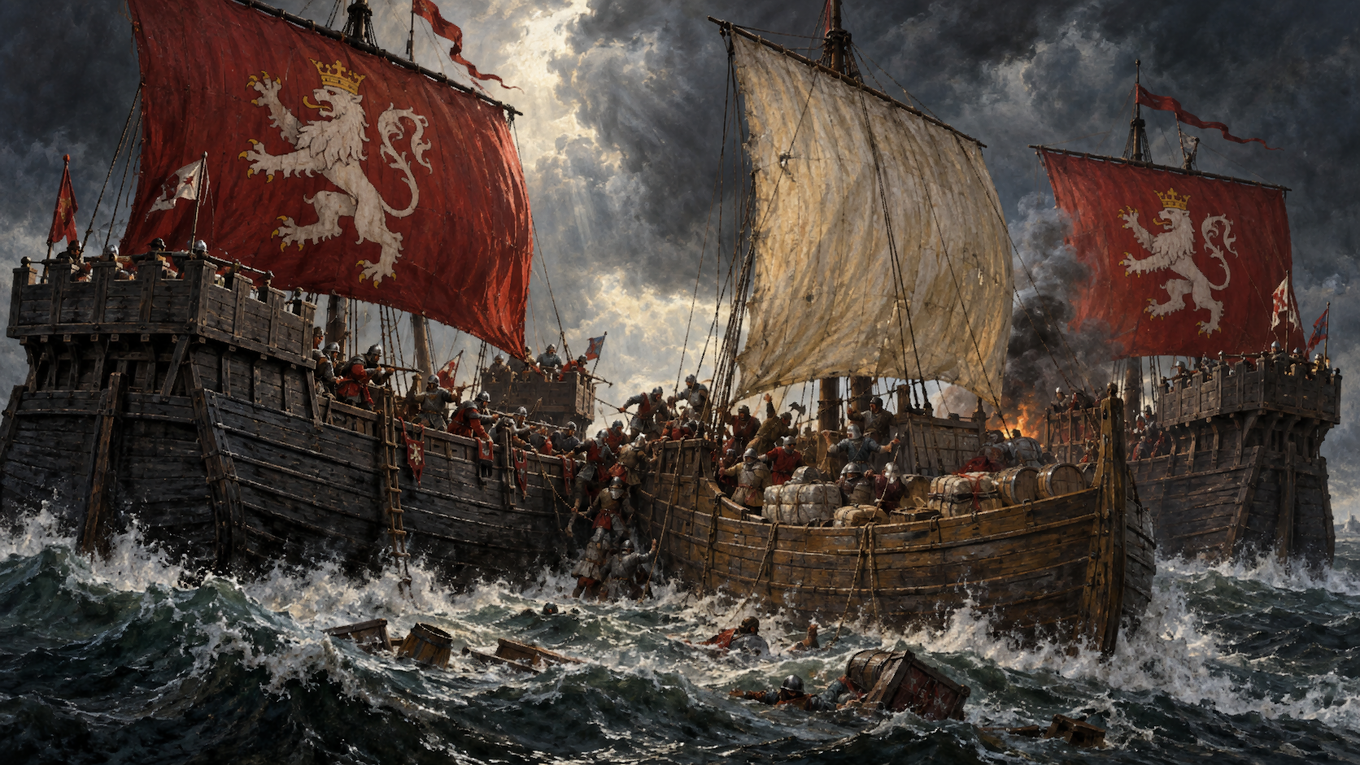
The popular story says she sold her estates to buy three warships, painted them black, dyed their sails red and named her flagship My Revenge. It says she hunted French ships across the Bay of Biscay and the English Channel, killed their crews, and left one or two survivors to carry the news to the King. The biographer Laure Buisson thinks Jeanne probably had around two ships and a hundred men, not the four hundred of legend. She likely operated from her family’s fortress on the island of Yeu.
Whatever its size, her fleet was fighting in the service of England. Edward III granted her an income from lands under English control in Brittany in 1343, and when England and France agreed the Truce of Calais in 1347, she was named in it as one of England’s allies.
Adrift
For thirteen years, she waged her war of revenge, until the French finally caught up with her and sank her flagship. Jeanne escaped in a small boat with her two young sons, drifting for five days without food or water. Guillaume, the younger boy, died of cold, thirst and exposure before the survivors finally reached Morlaix, on the Breton coast, where supporters of Montfort took them in.
After the war
Jeanne’s surviving son, Olivier, was taken to England and raised at the court of Edward III. In around 1349 or 1350 Jeanne married for the fourth time. Her new husband was Walter Bentley, Edward III’s commander in Brittany, who won the Battle of Mauron against the French in 1352. They fought for years to recover her confiscated lands, and in 1357 they were granted the barony of La Roche-Moisan. Jeanne settled at the castle of Hennebont on the Breton coast, in territory held by Montfort’s allies. Bentley died in late 1359, and Jeanne died a few weeks later.
Her son Olivier grew into one of the most feared soldiers of his age. He lost an eye fighting for Montfort, then changed sides and fought for the French crown against the English. His brutality towards prisoners earned him the nickname “the Butcher,” and he eventually became Constable of France, commander of the army of the kingdom that had beheaded his father.
How much of it is true?
Jeanne de Clisson is real, and so are the core facts of her story. Her husband’s execution is recorded in official documents. The French crown banished her and seized her lands. English records name her as an ally. And two medieval chronicles say that she slaughtered a garrison and went to sea to kill French merchants.
However, there are no records of the black ships, the red sails, the name of the flagship or the survivors spared to carry her message. Much of the colour comes from nineteenth-century writers, including the romantic novelist Émile Péhant, whose Jeanne de Belleville was published in 1868. Even so, the real Jeanne remains a remarkable figure: a widow who met a king’s cruelty with her own, and waged a private war against France for the rest of her life.
Questions and answers
Why was Olivier de Clisson executed?
He was accused of treason after being released by the English on unusually easy terms following the fall of Vannes in 1342. The French crown claimed he had made a secret alliance with Edward III of England. The evidence was never made public, and his execution during a truce shocked the nobility.
Was Jeanne de Clisson really a pirate?
Yes, in the sense that she led armed raids at sea. Two medieval chronicles record that after her husband’s death she went to sea with a large force and killed many French merchants. She did so as an ally of England rather than as an independent outlaw, and English records name her among Edward III’s allies.
What happened to her sons?
Her younger son, Guillaume, died around 1345. According to legend he died of exposure after her ship was sunk and the family were left adrift. Her elder son, Olivier, was raised in England and became a famous soldier known as “the Butcher,” and eventually Constable of France.
Key dates
- 1300
- Jeanne de Belleville is born in Poitou, heiress to lands on the border of Brittany
- 1330
- She marries Olivier IV de Clisson, one of the most powerful lords of the Breton border
- 1341
- The War of the Breton Succession begins; the Clissons side with Charles de Blois and the King of France
- Late 1342
- Olivier is captured when the English take Vannes, and released on suspiciously easy terms
- 2nd August 1343
- Olivier is beheaded in Paris; his body is hung at Montfaucon and his head sent to Nantes
- 1343
- Jeanne seizes a castle held for Charles de Blois, kills its garrison and takes to the sea; she is banished and her lands confiscated
- 1347
- Jeanne is named as an ally of England in the Truce of Calais
- c. 1349–1350
- She marries Walter Bentley, Edward III's commander in Brittany
- 1359
- Jeanne dies at Hennebont, a few weeks after Bentley
Further reading

Pirate Women: The Princesses, Prostitutes, and Privateers Who Ruled the Seven Seas
Laura Sook Duncombe · A collective history of women pirates across the centuries, including a chapter on Jeanne de Clisson.
View on Bookshop.org: Pirate Women: The Princesses, Prostitutes, and Privateers Who Ruled the Seven Seas
Jeanne de Clisson: The Widow's War
Hilmarj Torgrim · A historical novel imagining Jeanne de Clisson's revenge at sea, book 14 in the Pirate Women series, with a historical timeline at the back to separate fact from invention.
View on Bookshop.org: Jeanne de Clisson: The Widow's WarThis article contains affiliate links. If you buy through them, Yorewire may earn a small commission at no extra cost to you. Affiliate disclosure.
Sources
- 1Chronique normande du XIVe siècle, ed. Auguste and Émile Molinier (Paris, 1882), pp. 60–61 (Fourteenth-century Norman chronicle; the earliest narrative of Olivier's execution, Jeanne's attack on the castle and her killing of French merchants at sea.)
- 2Chronographia regum Francorum, vol. 2, ed. Henri Moranvillé (Paris, 1893), pp. 205–206 (Latin chronicle of the French kings, closely following the Chronique normande but giving her 400 men; the editor's notes doubt that the castle was really Brest.)
- 3Katrin E. Sjursen, 'Pirate, Traitor, Wife: Jeanne of Belleville and the Categories of Fourteenth-Century French Noblewomen', in Heather J. Tanner (ed.), Medieval Elite Women and the Exercise of Power, 1100–1400 (Palgrave Macmillan, 2019) (The main modern academic study of Jeanne and her reputation.)
- 4'Who was France's fiercest female pirate, the Lioness of Brittany?', Connexion France (Interview with Laure Buisson, author of the biography Pour ce qu'il me plaist: la première femme pirate, on what is documented and what is legend.)
- 5'Jeanne de Clisson', 'Olivier IV de Clisson' and 'Olivier V de Clisson', Wikipedia (Used for family details, the official record of Olivier's execution, and the documents that confirm her English alliance; its accounts of her piracy mix history with later legend.)