The Man Who Was Roasted on a Throne then Eaten Alive
György Dózsa was meant to lead a crusade against the Ottomans. Instead he led tens of thousands of peasants against Hungary's own nobility, and paid for it on a throne of red-hot iron while his starving followers were made to eat him alive.
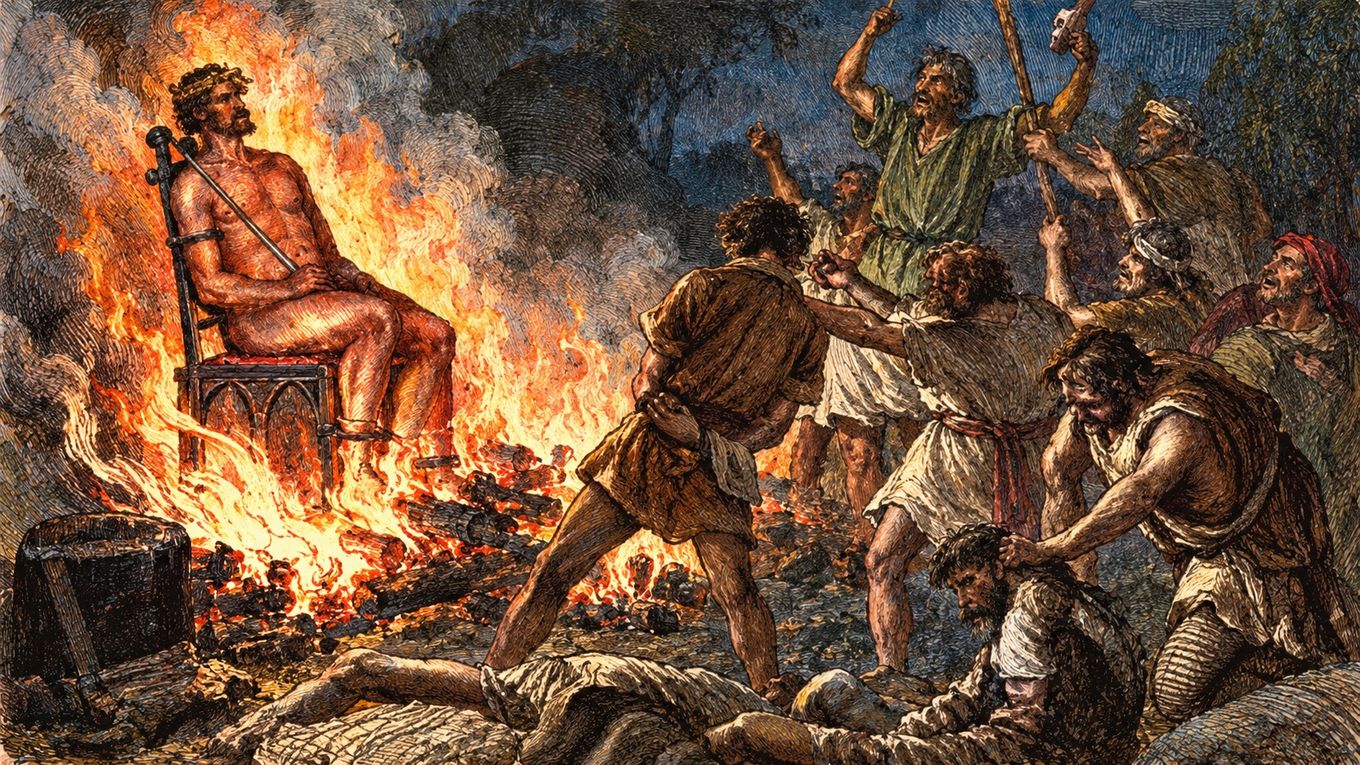
In the summer of 1514, in the marketplace at Temesvár, a man was stripped naked and made to sit on a throne of iron while it was heated beneath him. A crown of red-hot iron was pressed onto his head and a red-hot sceptre forced into his hand. Then, while he was still alive, his own followers, who had been deliberately starved in preparation, were made to tear the roasted flesh from his body with their teeth and eat it. The man was György Dózsa, and a few months earlier he had been a celebrated soldier, ennobled by the king for his valour against the Ottomans.
A soldier turned crusader
Dózsa was a Székely man-at-arms from Transylvania, not a peasant but a minor noble who had made his name fighting the Turks. Early in 1514 he won a duel against a renowned Ottoman champion outside Belgrade, reportedly hacking off his opponent’s armoured sword hand before killing him. He came home a celebrity, and King Vladislaus II (King of Bohemia, Hungary and Croatia) rewarded him with a village, a noble title and a coat of arms bearing a bleeding, severed arm still gripping a sword.
That same spring, Archbishop Tamás Bakócz of Esztergom returned from Rome with a papal bull from Leo X calling for a crusade against the Ottomans. Bakócz turned to the Franciscans to recruit ordinary people rather than noble retinues, and within a couple of weeks some 15,000 volunteers had gathered in the camp outside Pest (now the eastern half of Budapest). They called themselves Kuruczok, a Magyar corruption of cruciati, “crusaders.” Most were, as Robert Nisbet Bain writing for the Britannica put it, “the humblest and most oppressed portion of the community”: peasants, small yeomen, wandering students, friars and parish priests. Dózsa was given command, though the surviving records are muddled enough that historians still disagree over exactly when and how that came to pass.
From crusade to civil war
The crusading army never left Hungary; nobody had arranged to feed or clothe it. As the harvest approached, landlords ordered the volunteers home to bring in the crops, and when they refused, the lords beat and abused their wives and families and set armed retainers on the half-starved crowds in the camps. “Instantly,” Bain wrote, “the movement was diverted from its original object, and the peasants and their leaders began a war of extermination against the landlords.” Bakócz called the crusade off, but Dózsa, his younger brother Gergely, and a core of Franciscan agitators led by Lőrinc Mészáros, the radical parish priest of Cegléd, refused to disband.
The revolt did not stay in the countryside. Rebellious sympathies spread quickly, with townspeople taking the rebels’ side. In Buda and elsewhere, cavalry sent out against the Kuruczok were dragged from their horses by the town crowds as they rode through the gates.
From Dózsa’s camp at Cegléd, bands fanned out in every direction, pillaging and burning. The revolt spread “like lightning” across the Magyar heartland and into Transylvania. Hundreds of manor houses and castles went up in flames, and thousands of the gentry were killed by impalement, crucifixion and what Bain called “other unspeakable methods.” An Italian living in the region, Giovanni Vitale, wrote that year of nobles impaled before the eyes of their wives and children, and of wives raped while their husbands were forced to watch. At Csanád, Dózsa took the city and fortress and celebrated by impaling the bishop and the castellan. At Arad, the royal treasurer István Telegdy was “tortured to death with satanic ingenuity.” However, only “notorious bloodsuckers, or obstinately resisting noblemen” were killed this way; nobles who surrendered were allowed to live, Dózsa himself never broke his word, and even helped some noble fugitives escape, though he struggled to hold back his followers “when their blood was up.”
King Vladislaus II revoked the crusade and ordered the peasants home on pain of death. It made no difference. Every feudal levy in the kingdom was called up, and mercenaries were hurriedly hired from Venice, Bohemia and the Holy Roman Empire. Through the summer Dózsa took the fortresses of Arad, Lippa and Világos, equipping himself with cannon and trained gunners.
The slaughter at Temesvár
Though Dózsa was winning his war against the nobles, Bain wrote that he “had become demoralized by success,” and that after Csanád he “issued proclamations which can only be described as nihilistic.” The rebel leadership’s aims, as the historian Sándor Márki later reconstructed them, would have torn down the whole social order: abolish the nobility, share the lands of the nobles and the Church equally among the peasants, replace every bishop with a single elected bishop for the whole country, and in the end do away with the kingdom itself. The crusaders called themselves subjects of the king but not of the bishops and lords, and wherever they caught bishops or nobles, they impaled them.
Meanwhile, the peasant army kept growing. The 15,000 who had gathered at Pest in the spring had swelled their ranks as the revolt spread from county to county. A panicked letter sent abroad from Buda on the 17th June claimed there were more than a hundred thousand crusaders and that their numbers were growing every day. That was likely an exaggeration, but Márki puts Dózsa’s main army at about 40,000 by the time it reached Temesvár on the 15th June.
Temesvár was the best defensive position in southern Hungary, ringed by the rivers Temes and Béga and their marshes. Inside, Stephen Báthory, the count of Temes, had shut himself up with other lords and their wives and children. Dózsa bridged the river, dragged his wheeled cannon across and began pounding the walls. For a month he kept up the siege, trying to drain the marshes and bringing up heavier guns. In desperation Báthory appealed for help to John Zápolya, the voivode of Transylvania, a personal enemy, and the 27-year-old Zápolya answered. He raised an army in Transylvania at his own expense, after first ensuring the kingdom would pay him back, and marched hard for Temesvár with guns of his own.
His force numbered some 20,000 the core was Zápolya’s own household troops and swift light cavalry: Székely horsemen from Transylvania and mounted border troops, some of them Serbs, backed by Transylvanian nobles who rode out once they saw the voivode was serious. The king later spoke of Zápolya arriving with “domestic and foreign” forces. Meanwhile, elsewhere in the kingdom, royal commanders were breaking up smaller rebel camps with cannon, heavy cavalry and hired German infantry.
On the 15th July, a scorching Saturday, Zápolya’s men formed up unseen, probably screened by woodland, and advanced on the rebel camp to drums and trumpets. Dózsa took the centre, his brother Gergely the right wing and the friar Lőrinc Mészáros the left. For a long while the fight hung in the balance, and the peasants held out far longer than anyone expected. The battle was decided in the centre, where Zápolya’s better-armed household troops and the Székely and border horsemen charged again and again until the crusaders began to give way. Dózsa tried to rally the fleeing men and, the chroniclers say, cut down two armoured men with a single stroke. Then Zápolya’s young kinsman Péter Petrovics spotted him, galloped toward him and drove a lance into his side. Wounded, Dózsa slid from his horse and was captured, Gergely was taken at almost the same moment.
With its leaders gone, the peasant army fell apart, and the battle became what Márki calls a “wild massacre.” Zápolya proclaimed a pardon for anyone who laid down his arms and went home. The peasants threw away their weapons and fell to their knees with clasped hands, begging for mercy and pleading for the lives of the wives and children in their camp. But the nobility, now out for revenge and looking to make an example, “spared no one.” Most were hacked down where they knelt or dragged off in chains. Many more were cut down as they fled, many were mutilated, and many drowned in the Béga while Zápolya’s troops blocked the crossings. Only those who had run early, or who knew the paths through the marshes, got away. Lőrinc Mészáros was one of them.
Márki suggests perhaps 20,000 died, not counting the women and children captured in the camp, most of whom he says later starved to death. Legend has it that Zápolya was so haunted by what he had done that he could never again bear to look at the raised host at Mass.
The execution
What followed shocked even a Europe desensitised to public torture. The first surviving report comes from King Vladislaus himself, in a letter dated the 24th July, which the historian Paul Freedman describes as “rather cheerful.” Its Latin is brutally descriptive. Dózsa was first crowned with red-hot iron, then, naked and bound at the feet, he was torn apart with teeth and devoured alive by his own soldiers, the men he had liked to call, half in jest and half in earnest, his “beasts.” His corpse was then cut into four pieces and hung from the gallows. The king thought this an entirely fitting punishment.
A German pamphlet printed in Nuremberg that same year adds a detail that makes the scene even more grotesque. While the execution was being set up, pipes and violins played. As Dózsa roasted, dancing monks sang a Te Deum, the Church’s hymn of thanksgiving.
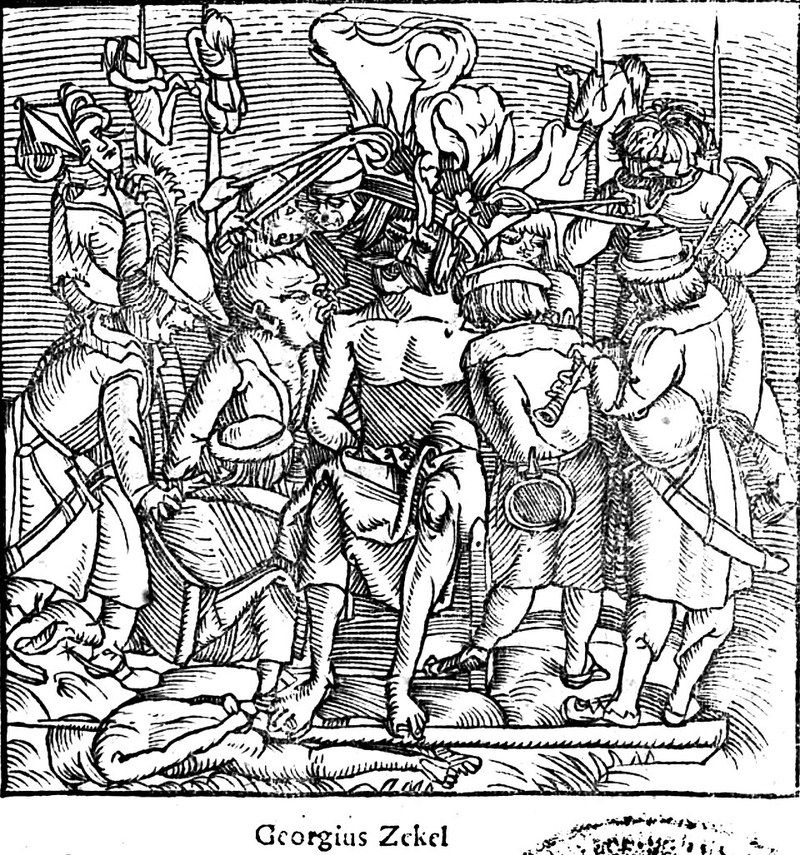
The most detailed account of the execution, drawn from later Hungarian accounts, runs like this. Dózsa was stripped and seated on the heated throne, then a red-hot iron crown and scepter were forced upon him. Nine of his followers, starved beforehand, were led up to him. His brother Gergely went first and was cut into three pieces in front of him, despite Dózsa’s pleas that he be spared. Executioners then drew pincers from the fire, drove them into Dózsa’s body and ripped away his flesh. The remaining men were ordered to bite into the burning wounds and swallow what came away. Those who refused were hacked apart on the spot. Freedman’s account adds that Dózsa, “partially roasted” but still alive, was taken off the throne so that his followers could eat him.
The men who complied were released. What was left of Dózsa was quartered and the pieces sent around Hungary for display.
While barbaric the punishment wasn’t merely cruelty for its own sake. Freedman points out that a heated crown or throne was already a recognised punishment for people who claimed authority above their station. More than three centuries earlier, in 1197, Emperor Henry VI had a red-hot crown nailed to the head of a Sicilian rebel who had claimed to be king. Guillaume Cale (Jacques Calle), a leader of the French Jacquerie of 1358, was stripped, set on hot iron and crowned with a burning iron circlet. Forced cannibalism had a Hungarian precedent too, during the 1456 crusade to relieve Belgrade, a man caught plotting to betray the army was burned at the stake and his accomplices were made to eat his charred remains.
Aftermath
The reprisals were savage. Nobody counted the dead. Sixteenth-century writers gave figures of 40,000 (the historian Miklós Istvánfi), 70,000 (the humanist Johannes Cuspinianus) and even 80,000 peasants killed, and later writers have wavered between the three. The nobles’ revenge did not end on the battlefield; they wrote it into law. The jurist István Werbőczy’s Tripartitum, drawn up in its wake, greatly strengthened the position of the lesser nobility over the peasantry, a divide that lasted until serfdom was abolished in 1848. Some historians also credit the crushed revolt, and the resentment it left behind, as one reason Hungary was so divided when the Ottomans invaded twelve years later.
Dózsa himself became one of those historical figures endlessly reshaped to fit whoever was telling his story. In the nineteenth century he became a romantic hero, the subject of Ferenc Erkel’s opera Dózsa György. Hungary’s Communist government after 1945 turned him into a proto-socialist martyr: he appeared on the 1947 forint banknotes, a monument went up in a square named after him below Buda Castle, and from 1950 to 1990 one of the country’s most popular football clubs bore his name. Budapest still has a Dózsa György út and a metro station named after him. However, in 1972 the historian Jenő Szűcs questioned how anti-feudal and anti-clerical the revolt really was, and by its 500th anniversary in 2014 Hungarian historians were treating Dózsa as a far more complicated figure than either the nationalists or the Communists had allowed.
Questions and answers
Was Dózsa really eaten alive, or is that a later exaggeration?
The core of the story comes from the most contemporary source available: a letter from King Vladislaus II himself, which says Dózsa was crowned with red-hot iron and then “torn apart with teeth and devoured alive” by his own soldiers. A German pamphlet printed in 1514 tell’s the same story. Later accounts vary on details such as how many followers were brought forward and how many refused to eat, but the roasting and the forced cannibalism are not disputed.
Why a throne, crown and sceptre?
Mock coronations of rebels who had claimed authority above their station were an established form of exemplary punishment in medieval Europe. They were used against a rebel leader in Sicily in 1197 and against a leader of the French Jacquerie in 1358. Dózsa had led an army that wanted to abolish the nobility, and the burning crown mocked his ambition.
Did Dózsa intend to lead a peasant uprising?
Not at first. He was appointed to lead a papal crusade against the Ottomans. The revolt only began once landlords tried to force the unfed peasant army back to the fields at harvest time, abusing their families and sending armed men against them. After that, Dózsa and his brother chose to keep fighting rather than disband. The original goal was a war against the Turks, not the Hungarian nobility.
Who were the Franciscans?
The Franciscans are a Catholic order of friars founded by St Francis of Assisi in the early thirteenth century and devoted to poverty and preaching. In 1514 Archbishop Bakócz put them in charge of recruiting for the crusade. Radical ideas about social equality had been circulating among Hungary’s Franciscans for decades, and some friars had been preaching against the feudal order. When the crusade turned into a revolt, several of them, above all Lőrinc Mészáros of Cegléd, became its most militant leaders.
Key dates
- c. 1470
- György Dózsa is likely born in Transylvania, though nothing certain is known about his early life
- 28th February 1514
- Dózsa wins a duel against an Ottoman champion outside Belgrade and is ennobled by King Vladislaus II
- April 1514
- Archbishop Tamás Bakócz returns from Rome with the papal crusade bull; Franciscan friars begin recruiting a peasant army
- Late May 1514
- Landlords order the unfed crusaders home for the harvest and turn on their families; the revolt against the nobility begins
- 15th June 1514
- Dózsa's army, now about 40,000 strong, lays siege to Temesvár
- 15th July 1514
- The peasant army is routed at Temesvár by John Zápolya and Stephen Báthory; Dózsa is captured
- 20th July 1514
- Dózsa is roasted on a red-hot iron throne at Temesvár and eaten by his own men; King Vladislaus describes the execution in a letter dated the 24th July
Further reading
A Concise History of Hungary
Miklós Molnár · A thousand-year history of Hungary that covers the 1514 peasant revolt led by György Dózsa.
View on Bookshop.org: A Concise History of HungaryThis article contains affiliate links. If you buy through them, Yorewire may earn a small commission at no extra cost to you. Affiliate disclosure.
Sources
- 1Robert Nisbet Bain, 'Dozsa, György', Encyclopædia Britannica, 11th edition (1911), vol. 8 (The original 1911 entry, based on Sándor Márki's 1884 biography; source of the account of the townspeople joining the revolt and of the half-roasted Dózsa being devoured by his starved followers.)
- 2Sándor Márki, Dósa György 1470–1514 (Budapest: Magyar Történelmi Társulat, 1913) (The standard Hungarian scholarly biography (in Hungarian), built on the contemporary chronicles and letters; source for the siege and battle of Temesvár, the size and make-up of both armies, the massacre, and the chroniclers' death tolls.)
- 3Paul Freedman, 'Representations of Peasant and Seigneurial Fury in Late Medieval and Early Modern Europe', Temas Medievales 19(1), 2011 (Peer-reviewed academic article; quotes King Vladislaus II's letter on the execution and the 1514 Nuremberg pamphlet, and traces the iron throne/crown punishment to earlier precedents.)
- 4László Veszprémy, 'The Changing Perception of the Hungarian Peasant Uprising of 1514', Hungarian Conservative, 1 May 2023 (Written by a military historian and former head of the Military History Institute in Budapest; covers the shifting historiography and political use of Dózsa's memory.)
- 5'György Dózsa', Wikipedia (Draws on Márki (1913), Pataki (1971), Szűcs (1974) and Barabási; useful for the narrative detail and its own citations.)