The Queen Who Served Justice in a Nutshell
For thirty-three years, Madagascar's justice system came down to one question: could you vomit up three pieces of chicken skin after eating a poison nut? Queen Ranavalona turned an old tradition into a justice system that killed on an industrial scale.

As the cocks crowed the officials came to the house. They knocked, and called the accused’s name three times. At full daylight the accused was led out with a mat over his head, then brought back in to sit on the floor. In front of him was a hole with a fish-basket in it, there to catch his vomit. He ate as much rice as he could. Then he swallowed three pieces of chicken skin, whole and without chewing. Next came a drink of banana juice with shavings of a poisonous nut scraped into it. An official placed a hand on his head and began to pray to the poison. If it found him guilty, it was to “burst his bowels” and “break his heart.”
If all three pieces of skin came back up into the basket, he was innocent. If they didn’t, he was guilty, and if the poison hadn’t already killed him, he was beaten to death with a rice pestle.
This was the tangena, and for most of the nineteenth century it was the heart of justice in the kingdom of Madagascar. It reached its peak under Queen Ranavalona I, who ruled from 1828 to 1861. Tens of thousands died. What is harder to grasp today is that most of the population, including many of the accused, participated willingly.
The wife who stole the throne
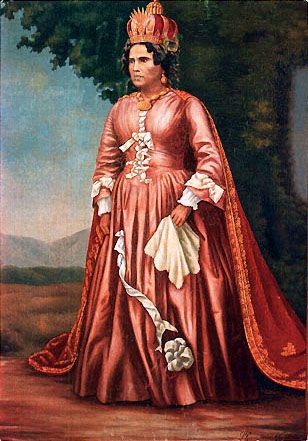
Ranavalona was born Princess Ramavo in 1778, at a royal residence east of Antananarivo. She owed her place in the royal family to her father. When she was a girl, he warned King Andrianampoinimerina of an assassination plot by the king’s own uncle. In gratitude, the king betrothed her to his son and heir, Radama, and declared that any child of theirs would be first in line to the throne after him.
The marriage brought her rank and not much else. Ramavo was not Radama’s favourite wife and they had no children. When Radama became king in 1810, he followed royal custom and had several potential rivals among her relatives executed. The neglected queen spent most of her days with other court ladies, drinking rum and socialising at the missionary house.
When Radama died on the 27th July 1828, custom gave her no claim to the throne. The rightful heir was his nephew Rakotobe, the eldest son of Radama’s eldest sister. But the two courtiers at Radama’s deathbed kept his death secret for several days, afraid of reprisals from rivals. That delay was all it took. A senior officer named Andriamamba found out, and together with several military officers he threw his support behind Ramavo. They hid her somewhere safe, won over the judges and the keepers of the sampy, the sacred royal talismans, and brought the army round.
On the 11th August 1828 Ramavo declared herself Radama’s successor, claiming he had chosen her himself, and nobody was in a position to resist. She took the name Ranavalona, meaning “folded” or “kept aside.” Then she did to Radama’s family what he had done to hers. Rakotobe, his family and other relatives of Radama were hunted down and put to death. She was the first woman to rule Imerina since the kingdom’s founding almost three centuries earlier, in a culture that regarded women as wholly unsuited to rule.
Her first lover as queen was Andriamihaja, the young officer who had helped put her on the throne. He spoke English and French, was a leader of the court’s pro-European faction, and was almost certainly the father of her only son, Rakoto, born eleven months after Radama died. But the conservative and anti-European members of the court, backed by the keepers of the talismans and the chief diviners, persuaded the queen that he was plotting against her. In September 1830 he was charged with witchcraft and treason; according to one account the queen signed his death warrant while drunk, and another says he refused to take the tangena, knowing the dose would be fixed to kill him. He was stabbed to death.
An old tradition
The tangena ordeal was already old by the time Ranavalona was born. Malagasy oral histories record that in the early 1600s King Andrianjaka changed the rules: instead of giving the poison to the accused person’s rooster and judging by whether the bird survived, the accused would take it themselves. Around 1800 Andrianampoinimerina, the king who unified the highland kingdom of Imerina, took the ordeal under royal control. He decided who could administer the poison and ruled that owning unlicensed charms was evidence of witchcraft. The Malagasy historian Raombana recorded that he would sometimes order the whole population of towns and villages, children excepted, to take the tangena, and that “a great number of them dies through this horrible Test.”
Even Radama I, Ranavalona’s husband, admired by the British as an enlightened moderniser, did not dare get rid of it. Urged to abolish it by a British agent, he reportedly said that if he did, “the most terrible anarchy would prevail throughout the island.” Raombana, who later served as Ranavalona’s secretary, summed it up: “Literally speaking, the Tangena ordeal is the sovereign of Madagascar.”
What changed in 1828 when Ranavalona ascended the throne was the scale. The generals and officials of the old guard who had helped put Ranavalona in power wanted to restore the traditional religious order that Radama had neglected. In that system the poison ordeal was the surest way to root out mosavy, witchcraft. According to the historian Stephen Ellis, her government oversaw the use of the tangena on “entire population groups on an unprecedented scale.”
The spirit in the nut
The tangena is the kernel of a nut, it grows inside the plum-like fruit of Cerbera manghas, a small and deceptively attractive tree. To the Malagasy the nut was alive. It held a spirit named Manamango, and the officials administering it addressed it directly, as a god that could see without eyes and hear without ears. One Malagasy later explained that people believed the spirit entered the stomach with the poison and searched the accused’s heart, punishing the guilty and sparing the innocent.
The ritual that William Ellis recorded in 1838 was elaborate. Before a village was tested, a lamb was killed and deliberately mangled, its head placed at its tail and its feet cut off and reversed, while anyone who accused out of malice was cursed to suffer the same fate. Then the accusations came: someone had been seen dancing on a tomb at night, nursing a wild cat in a ditch, or entering a house at midnight. The poison was first tested on two chickens, one meant to die and one to live. If both died or both lived, the batch was rejected.
Then came the prayer to Manamango, a long chant several times the length of the extract Ellis printed. If the accused was a sorcerer, it demanded:
kill him quickly; kill him immediately, let him die forthwith, kill him without delay; burst him, and tear his flesh, and tear his arms into pieces; break his heart, burst his bowels.
The accused was then made to drink rice-water again and again until he vomited, and the officials searched the fish-basket for the three pieces of skin. If he had bitten one, that alone was proof of guilt.
How the poison killed
The nut contains cardiac glycosides, poisons in the same family as the heart drug digoxin. They jam the sodium-potassium pumps that heart muscle cells need in order to beat in rhythm. The heart slows, its electrical signals start to falter and eventually the heart stops altogether. The first symptoms are a burning mouth, nausea and violent vomiting. In modern cases of deliberate poisoning with the closely related Cerbera odollam, death usually comes within about three to six hours.
That cruel detail sat at the centre of the ordeal. The poison made people vomit, which was the only way to prove innocence. In small doses it worked mainly as an emetic, and the verdict depended on whether the three pieces of skin came up before the poison reached the heart. However, vomiting can take more than an hour to start, so many were declared guilty and killed before the poison had even taken effect.
After the verdict
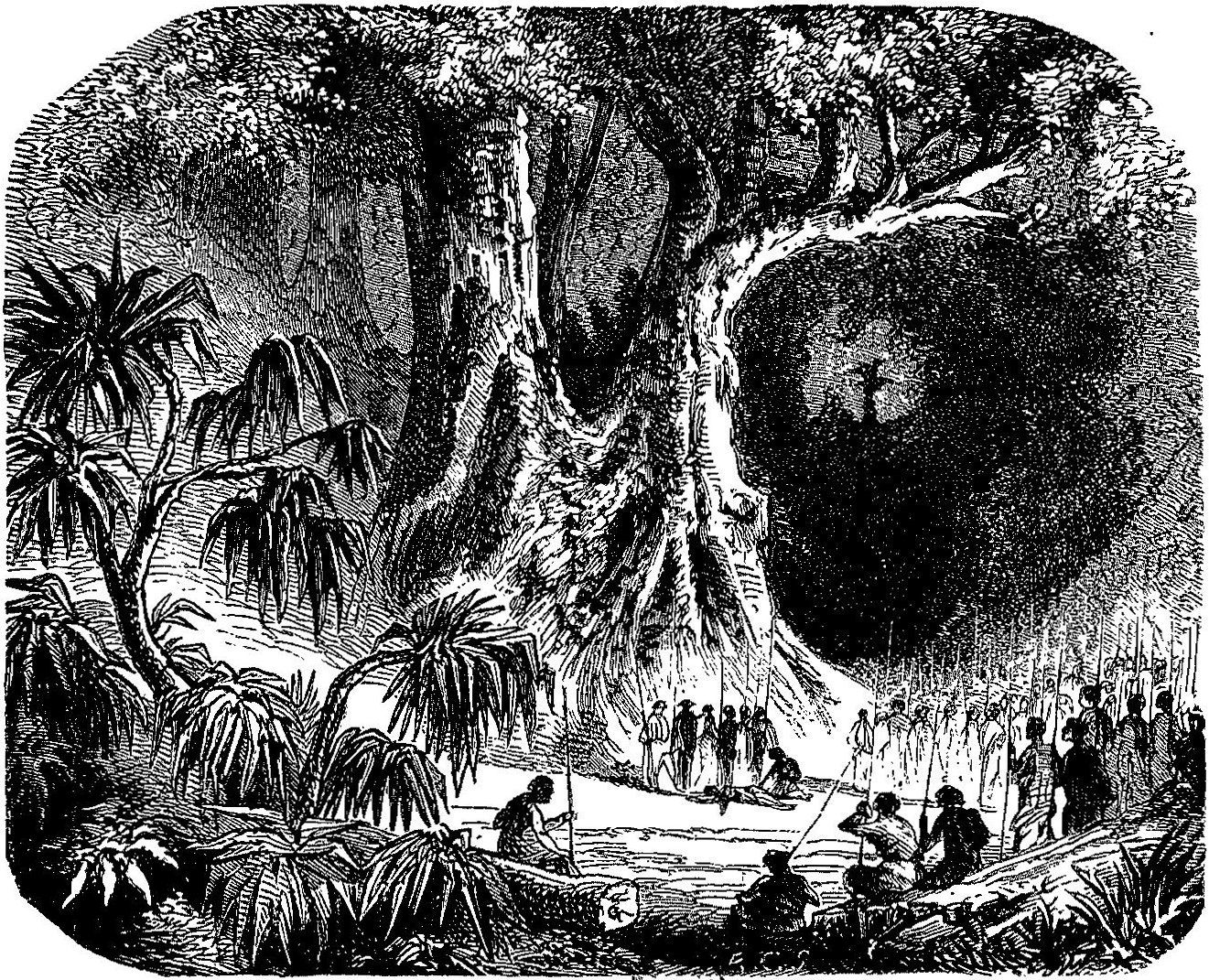
For the guilty, death was often not quick. Those who survived the poison but failed to bring up the skins were beaten with the rice pestle. Ellis thought it “extremely probable that many of the sufferers are buried alive.” Others were strangled or smothered by people in such a hurry to leave the house before the dying person’s spirit escaped that they didn’t finish the job. In 1829 a man who took only part of his dose and refused the rest had his brains dashed out on the spot.
The bodies were wrapped in old matting and dragged away with their heads pointing south, a mark of dishonour. Some were buried hastily. Others were simply left out for dogs and birds of prey. They could never be placed in the family tomb. Their property was confiscated, “even down to the rice-measure,” and divided between the crown, the judges and the accusers.
Those who made it through were carried home in procession by relatives in their best clothes, singing and clapping, and a feast followed, but anyone who died within twelve days of passing the ordeal was reclassified as guilty after all.
Justice for sale
Many Malagasy knew the system could be rigged. The officials who prepared the dose could, as Ellis put it, “permit any criminal to escape” for a bribe, or make sure of a death. Those who “died” in the ordeal were sometimes secretly revived with herbal draughts and sold into slavery far away. The official who administered the poison took a twenty-fourth share of a dead person’s property, and accusers shared in what was confiscated, which gave everyone a reason to accuse.
Under Ranavalona the ordeal became, in Stephen Ellis’s words, “a weapon of elite rivalry.” Even the prime minister, Rainiharo, could not protect his own household: his wife, his sister-in-law, two sisters and a cousin were all made to take the tangena, all five failed to bring up the chicken skin, and all five were strangled. Generals used accusations against the local officials of their rivals and took their slaves, cattle and goods. When the queen toured a district known for unofficial charms in 1850, according to a later account, she had it surrounded by troops and made its people take the ordeal; thousands died.
There were at least three kingdom-wide ordeals, in 1829, 1843 and 1860. Each district had to name suspects by ballot to “cleanse” the kingdom. The Jesuit priest Marc Finaz, in Madagascar from 1855 to 1857, wrote that the tangena was used “on the slightest pretext and even without any pretext at all.” He believed almost every adult in Imerina had taken it, some more than a dozen times.
The people believed
The most disturbing thing about the tangena is not that a government used it but that the people trusted it. Raombana wrote that the public treated it as a kind of heavenly justice. Even when an innocent person was condemned, they accepted the verdict as just.
William Ellis was struck by how many Malagasy demanded the ordeal to clear their names. To refuse was taken as an admission of guilt, and someone who had passed could hold their head high and even claim damages from their accuser. Some people denounced themselves, because a confession spared their families from being sold into slavery.
Ellis told one story that captures this faith better than any statistic. When the wife of an officer died of illness in the 1820s, her mother, her sister, her husband’s mother and two other relatives, the whole grieving family, begged King Radama for permission to take the tangena to prove they had not neglected her. Radama told them they were fools: out of five, one was bound to die. They insisted that only the guilty could be harmed, and that without the test the world would think them guilty. He gave in. The official, as Radama put it, made the draught “a little too bitter.” All five died, and according to Ellis, “not a tear was shed for them.”
The queen who kept Europe out
The same government that fed its people poison also kept Madagascar independent while European colonial empires were closing in around it. Early in her reign, Ranavalona tore up her husband’s treaty with Britain. In 1829 a French fleet attacked the east coast. Her army drove it back, and her envoys dragged out negotiations until malaria forced the ships to leave. In 1835 she banned Christianity for her subjects, and within a year nearly all the missionaries had gone.
In June 1845 British and French warships bombarded the port of Toamasina, burned the town and landed troops to storm the fort. They were driven back to their ships, leaving thirteen of their dead behind. Following Malagasy custom, the dead men’s skulls were set on poles in front of the fort. William Ellis saw them still there when he arrived eight years later. The queen responded by banning all exports, cutting off the rice and cattle trade that the French and British islands of Réunion and Mauritius relied on.
In 1857 a French adventurer, Joseph-François Lambert, plotted with members of the court to replace her with her more European-minded son. The plot failed, and the Europeans at court were ordered to leave the island for good. When Ranavalona died in her sleep in 1861, at the age of about 83, Madagascar was still independent. France would not conquer it until 1895.
Abolishment
Her son, Radama II, abolished the tangena soon after taking the throne in 1861. He also declared that its victims were no longer to be considered witches, and that their bodies could be moved into the family tombs at last. So many families had lost someone that the decree set off a wave of reburials across Imerina.
The ban did not end the belief. When Radama was strangled in a palace coup in 1863, his widow Rasoherina was allowed to take the throne only if she promised, among other conditions, that “the ordeal of tangena was not to be used.” In 1865 the ban was written into a treaty with Britain. The ordeal carried on in secret in the highlands and openly in parts of the island beyond the government’s reach. In April 1878, during a deadly fever epidemic, the people of a village just a few miles from the capital turned to the tangena, and several died. The government punished the whole village severely. The missionary James Sibree wrote in 1896 that the ordeal was “still believed in by numbers of the people” and that there had been further attempts to revive it.
As late as the 1980s, the anthropologist David Graeber heard rumours in the Malagasy highlands that some village councils had secretly brought back the tangena. He was never able to confirm them, but the rumours alone show how long the belief persisted.
Questions and answers
How many people died?
No one kept count, and the old royal archives contain no known records of tangena trials. In 1838 William Ellis estimated that about a tenth of the population took the poison at some point in their lives and that a fifth of those died. That meant one person in fifty, or some 3,000 deaths a year. Other estimates by people alive at the time, both Malagasy and European, run from 200,000 to 400,000 deaths across her thirty-three years. The central kingdom of Imerina had perhaps 500,000 to 600,000 people.
Did people believe the tangena was fair?
Most did. People who believed themselves innocent often demanded to take it, since refusing was treated as a confession. Some families insisted on taking it together to clear their names. At the same time, many recognised that the officials could manipulate the dose, and that accusers and officials profited from the property of those found guilty.
When did the tangena finally stop?
It was banned in 1861, the ban was confirmed in 1863 and written into a treaty with Britain in 1865, but it lingered. There are records of fatal use near the capital in 1878, and of attempts to revive it later. There were unconfirmed rumours of secret use as recently as the 1980s.
Key dates
- Early 1600s
- Oral histories record King Andrianjaka ordering the tangena poison to be given to the accused instead of to their roosters; the ordeal is already an old custom
- c. 1800
- King Andrianampoinimerina unifies Imerina and puts the poison ordeal under royal control
- 1778
- Ranavalona is born Princess Ramavo; she is later betrothed to Prince Radama as a reward for her father foiling a plot against the king
- 11th August 1828
- Two weeks after Radama I's death, Ramavo declares herself his successor with the army's backing and takes the name Ranavalona
- 1829
- First of three kingdom-wide poison ordeals; a French fleet attacking the east coast is driven off
- 1843 and 1860
- Second and third kingdom-wide administrations of the tangena
- 1861
- Ranavalona I dies; her son Radama II abolishes the tangena soon after taking the throne
- 1863–1865
- The ban is made a condition of Queen Rasoherina's accession and written into the Anglo-Malagasy treaty of 1865
- April 1878
- A village near the capital secretly resorts to the tangena during a fever epidemic; several people die
Further reading

Madagascar: A Short History
Solofo Randrianja and Stephen Ellis · A history of Madagascar covering the pre-colonial Merina kingdom under which Ranavalona I ruled.
View on Bookshop.org: Madagascar: A Short HistoryThis article contains affiliate links. If you buy through them, Yorewire may earn a small commission at no extra cost to you. Affiliate disclosure.
Sources
- 1Stephen Ellis, 'Witch-Hunting in Central Madagascar 1828–1861', Past & Present 175 (2002), pp. 90–123 (Peer-reviewed study by a leading historian of Africa; the main modern source on how the ordeal worked politically under Ranavalona, including the three general ordeals, death estimates and eyewitness testimony from the Jesuit Marc Finaz.)
- 2William Ellis, History of Madagascar, vol. 1 (London, 1838), ch. 17 (Detailed contemporary account of the ordeal's procedure, invocations and effects by a London Missionary Society historian, compiled from missionaries who had lived in Madagascar. Hostile to Malagasy religion, but its description of the ritual is corroborated by Malagasy sources.)
- 3William Ellis, Three Visits to Madagascar during the Years 1853–1854–1856 (London, 1858) (Eyewitness account of the skulls from the 1845 attack displayed at Toamasina, and of the trade embargo that followed.)
- 4James Sibree, Madagascar before the Conquest (London, 1896) (Missionary and ethnographer; records the ban in the 1865 treaty and the fatal use of tangena near the capital in 1878.)
- 5William Edward Cousins, Madagascar of To-day (London, 1895) (Records the abolition of the poison ordeal among the conditions imposed on Queen Rasoherina in 1863.)
- 6David Graeber, 'Catastrophe: Magic and History in Rural Madagascar', Campos 5(1), 2004 (Anthropologist's fieldwork; reports unconfirmed rumours in the 1980s that the tangena had been secretly revived.)
- 7'Ranavalona I', Wikipedia (Featured article; used for the queen's foreign policy, the 1829 French attack, the Lambert plot and changing historical views of her reign.)
- 8'Tangena', Wikipedia (Used for the early history of the ordeal, Radama II's decree on reburials, and Gwyn Campbell's estimates of annual deaths. Its claim that 100,000 people, 20% of the population, had died by 1838 misreads William Ellis and is not used here.)
- 9'Cerbera odollam', Wikipedia (Used for the typical time to death, citing Gaillard et al., Journal of Ethnopharmacology 95 (2004).)