The Ice Cream Ship That Sailed to War With the Pacific Fleet
With the US Navy completely dry since 1914, ice cream had become the sailor's great comfort. Sailors raided the freezer on a sinking carrier and froze it at 33,000 feet. In 1945 the Navy gave them a million-dollar concrete barge with its own ice cream plant, and towed it across the Pacific behind the fleet.
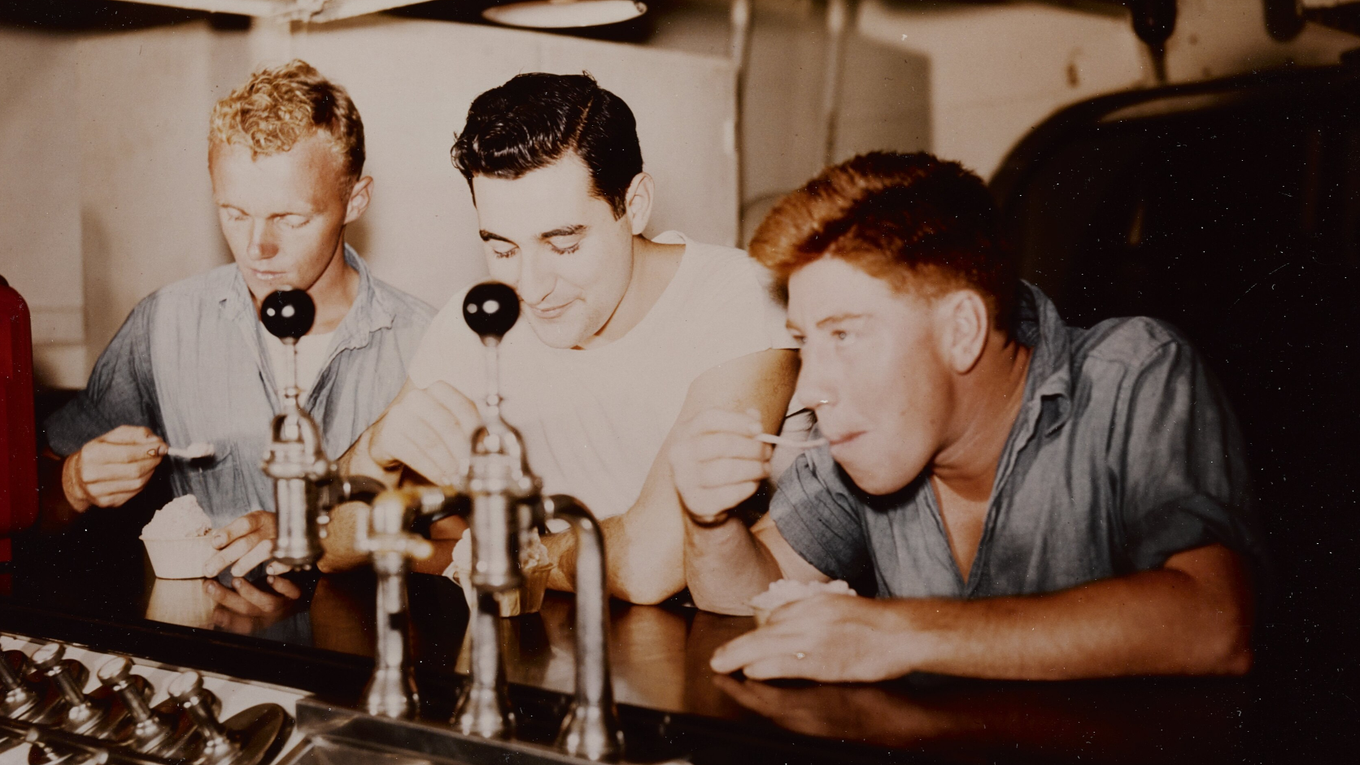

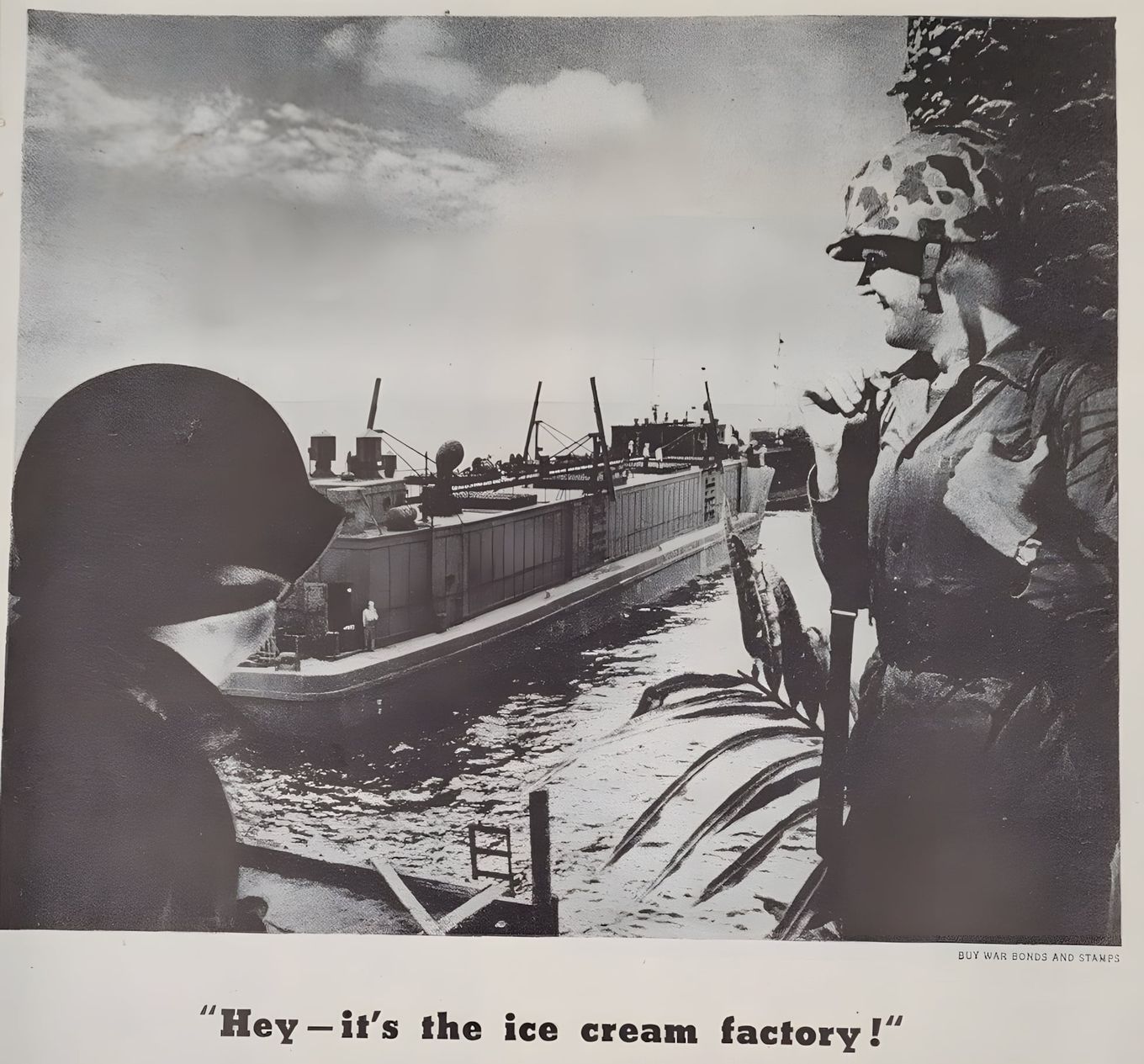
In the summer of 1945, among the warships, tankers and transports anchored in the lagoons of the western Pacific, there was a vessel unlike any other serving with the United States Navy. It was a huge concrete barge, 265 feet long, with no engines to drive it. It had to be towed from place to place. Inside a long wooden deckhouse it carried refrigerated holds full of frozen meat, vegetables and dairy goods. And it carried a machine that could make ten gallons of ice cream every seven minutes.
It had cost a million dollars. Its job was to keep the fleet in ice cream.
A dry navy
The American love affair with ice cream at sea grew out of a gradual decrease in alcohol. The US Navy had inherited the Royal Navy’s daily ration of spirits, and from 1794 every sailor was entitled to half a pint a day. The ration was halved in 1842 and abolished altogether on 1 September 1862, in the middle of the Civil War. In 1899 the Navy banned the sale of alcohol to enlisted men on ships and naval bases.
By 1914 the only drink left aboard American warships belonged to the officers, in the wardroom and the captain’s wine mess. The Secretary of the Navy, Josephus Daniels, was a teetotal newspaper publisher, and he finished the job. His General Order No. 99 banned “alcoholic liquors on board any naval vessel” from 1 July 1914. The press mocked him as “Admiral of the USS Grapejuice.” Much of the Atlantic Fleet was then lying off Veracruz in Mexico, and rather than waste the drink, the ships threw farewell parties and invited the crews of British, French, German, Spanish and Dutch warships to help them finish it.
From then on, every American warship was dry. Sailors looked for other comforts, and ice cream became one of the most popular.
By the Second World War, larger American warships had their own ice cream machines and snack bars, which sailors called the “gedunk.” Ice cream was more than just a treat; in the tropics a bowl of something cold was a huge boost to morale.
Sherbet in a helmet
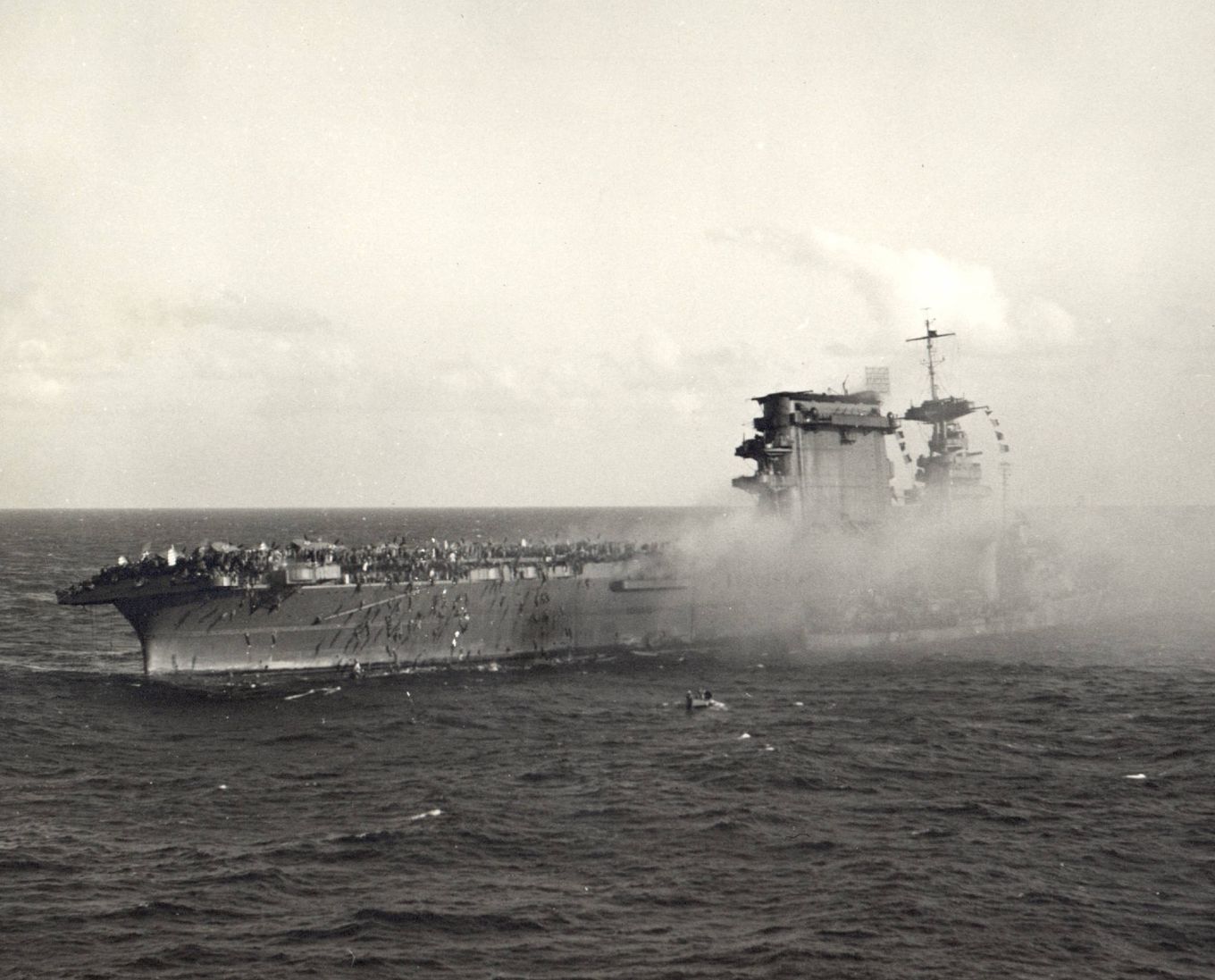
Just how much it mattered became clear on 8 May 1942, at the Battle of the Coral Sea. The aircraft carrier USS Lexington was hit by Japanese torpedoes and bombs. Fuel vapour spread through the ship, explosions tore through her and fires burned out of control below decks. Late in the afternoon her captain gave the order to abandon ship.
As the crew mustered on the flight deck, an 18-year-old aviation metalsmith named Julius Frey realised he was standing close to the gedunk. He climbed down over the side of the flight deck, broke the lock with a fire axe and used his helmet to carry the ship’s stock of pineapple sherbet up to his shipmates on the flight deck.

Ice cream at 33,000 feet
Away from the big ships, getting ice cream took ingenuity. In September 1944 the Marine fighter squadron VMF-122 was based on the island of Peleliu, which had no fresh food and no refrigeration. Its commander, J. Hunter Reinburg, had his mechanics bolt ammunition cans full of canned milk and cocoa under the wings of his Corsair fighter. He then logged a “test flight” and circled at 33,000 feet over Japanese-held islands, where the air was far below freezing.
His first attempt came back cold but runny. The second froze but was too flaky. For the third, his crew fitted the cans with small propellers that turned in the slipstream and churned the mixture as it froze. The result, Reinburg recalled, was smooth chocolate ice cream, ten gallons at a time, enough for 100 men. His superior officer soon caught on. He sent word that he was coming over the next day to “get my ration.”
A floating ice cream factory
The men on the Pacific Fleet’s small ships had no ice cream machines and no room for them. The answer came from a shipyard in California.
In February 1945 the trade journal Pacific Marine Review described three new “BRL” (Barge, Refrigerated, Large) vessels made primarily of concrete.
On deck stood an insulated wooden deckhouse 216 feet long, cooled by chilled air, over eight refrigerated holds. Four diesel engines drove generators that powered two 50-ton York refrigeration machines. Over the forward end was an upper deckhouse with a galley, mess rooms and quarters for the crew. And, the article noted, “a complete ice cream plant is included in the deckhouse,” with its own compressor and a hardening room where the ice cream was frozen solid for storage.

Off to war
The Navy borrowed at least one of the barges from the Army. According to the US Naval Institute, it cost $1 million, and it was towed around the Pacific to supply ice cream to ships too small to make their own. The Navy proudly announced that it could turn out ten gallons of ice cream every seven minutes and store 2,000 gallons at a time.
The barges followed the fleet as it closed in on Japan. The Navy’s official history of Pacific logistics records one, BRL-3071, at Buckner Bay on Okinawa in August 1945. On 7 August the food ship Latona began unloading her cargo into the barge for refrigerated storage. Three days later, news reached the anchorage that Japan had offered to surrender.
Questions and answers
Did the Japanese navy have anything like it?
It did, and long before the Americans. The Mamiya was a food supply ship of the Imperial Japanese Navy, completed in 1924, and served with the Combined Fleet, which from 1939 was commanded by Admiral Isoroku Yamamoto, the man who planned Pearl Harbor. She could carry enough food to feed 18,000 men for three weeks, and she had kitchens and professional confectioners on board. In 1928 her captain asked for proper machinery to make ice cream, ramune (a fizzy lemonade) and udon noodles. She became famous in the fleet for her ice cream, her monaka wafers and especially her sweet bean jelly, “Mamiya yōkan.” On the night of 20 December 1944 the American submarine USS Sealion torpedoed her in the South China Sea, then attacked again and sank her a few hours later. Her captain went down with her.
Did any country actually ban ice cream?
Britain did. In September 1942 the Minister of Food, Lord Woolton, refused to back down over a ban on making ice cream. Before the war the British had eaten 30 million gallons of ice cream a year, and the ban was expected to save 30,000 tons of transport and 1,000 tons of paper annually. The United States took the opposite approach and kept its armed forces supplied wherever it could.
Is alcohol still banned on US Navy ships?
Largely, yes. General Order No. 99 has been relaxed over the years, and alcohol is allowed in some controlled settings ashore and on special occasions, but American warships are still dry. Ice cream remains one of the principal comforts.
Key dates
- 1 September 1862
- The US Navy abolishes the daily spirit ration for its sailors
- 1 July 1914
- General Order No. 99 comes into force, ending the officers' wine messes and making US Navy ships completely dry
- 8 May 1942
- The carrier USS Lexington sinks at the Coral Sea; sailors raid the ice cream before abandoning ship
- September 1944
- Marine fighter pilots on Peleliu make chocolate ice cream by flying it to 33,000 feet
- February 1945
- Pacific Marine Review describes three new BRL refrigerated concrete barges, each with a complete ice cream plant
- August 1945
- The refrigerated barge BRL-3071 takes on provisions at Okinawa, days before Japan agrees to surrender
Further reading
Chocolate, Strawberry, and Vanilla: A History of American Ice Cream
Anne Cooper Funderburg · A history of American ice cream, including the industry and culture that produced the Navy's wartime love of it.
View on Bookshop.org: Chocolate, Strawberry, and Vanilla: A History of American Ice Cream
At War in the Pacific: Personal Accounts of World War II Navy and Marine Corps Officers
Bruce M. Petty · First-hand accounts from Navy and Marine Corps officers who served in the Pacific War, the kind of testimony behind stories like Harry Frey's sherbet rescue.
View on Bookshop.org: At War in the Pacific: Personal Accounts of World War II Navy and Marine Corps OfficersThis article contains affiliate links. If you buy through them, Yorewire may earn a small commission at no extra cost to you. Affiliate disclosure.
Sources
- 1'A Hundred Years Dry: The U.S. Navy's End of Alcohol at Sea' (1 July 2014) and 'Unique Ships of the U.S. Navy' (30 January 2015), USNI News (The US Naval Institute's histories of the Navy's alcohol ban and of the ice cream barge, including its $1 million cost and output.)
- 2K. M. Walker, '"BRL" Type Refrigerated Concrete Barges', Pacific Marine Review, February 1945, pp. 84–85, via the Internet Archive (A contemporary trade-journal description of the barges, their refrigeration machinery and their 'complete ice cream plant'.)
- 3Worrall Reed Carter, Beans, Bullets, and Black Oil (US Navy, 1953), chapter 30, via HyperWar (The Navy's official history of Pacific logistics, which records the refrigerated barge BRL-3071 at Okinawa in August 1945.)
- 4Kaila Peters, 'Another Cold One with the Boys: Coral Sea Veteran Laid to Rest with Shipmates', Navy.mil, 17 July 2017 (Quotes Lexington survivor Julius 'Harry' Frey's 2002 interview about raiding the ship's ice cream store.)
- 5Zach Rosenberg, 'DIY Ice Cream in Wartime', Air & Space Magazine, August 2018 (Summarises J. Hunter Reinburg's own account of making ice cream in Corsair fighters over Peleliu.)
- 6'IJN Mamiya: Tabular Record of Movement', Combinedfleet.com, and '間宮 (給糧艦)', Japanese Wikipedia (The service record of the Japanese navy's food supply ship and the history of her ice cream and confectionery equipment.)
- 7'Cable News in Brief', Otago Daily Times, 15 September 1942, via Papers Past (A wartime press cable reporting Lord Woolton's refusal to lift Britain's ban on making ice cream.)